| Society of Broadcast Engineers Monthly Newsletter on Career Advancement May 2011 |
|
|
| On the Horizon |
June
3-13 SBE Exams at local chapters
July
|
| Did you know? | |
There is still time to recommend a new member to the Society in the SBE Member Drive going on through May 31. |
|
Contact Information |
Certification Director Education Director |
|
|
| SBE Exam Deadline |
If you are interested in taking a certification exam during this exam time, please fill out the appropriate application and send it in to the national office for approval. See below for the application cut-off date and other exam opportunities.
SBE 2011 EXAM DATES LOCATION APPLICATION DEADLINE
August 5-15, 2011 local chapters June 3, 2011
November 4-14, 2011 local chapters September 16, 2011
If you have any questions, please contact the Certification Director, Megan Clappe. |
| SBE Celebrates Leadership Training! |
 | | 2010 SBE Leadership Development Class |
The SBE has always been committed to offering leadership training to broadcast engineers. Learning how to communicate with upper management, customers and others on your team are imperative for success. That's why we are extending two offers to compel you to better your leadership skills.
The SBE Leadership Development Course, a three-day intense and highly interactive course, takes place in Atlanta, August 2-4. Sign up for the course now, and you will get the Leadership Development Webinar Series for FREE to help you prepare. The cost for SBE Members is $580 and $630 for non-members. Topics of the course include the function and nature of leadership, generational differences in the workplace, a leadership style assessment, managing conflict and more.
 | | Online courses available on-demand |
|
|
|
|
|

|
| SBE entry-level certifications |
Are you new to the broadcast engineering field?
There are four entry-level certifications that may appeal to you.
If you are a working operator who wishes to certify your skills and knowledge or if you wish to become certified as your entry into the world of broadcasting then the Certified Television Operator or Certified Radio Operator certification may be right for you.
SBE Certification is not an FCC requirement, but it is evidence of an individual's qualifications to serve as an operator at a broadcast station and will be useful when seeking employment or career advancement. Many television and radio stations, as well as colleges and a couple of high schools in the country, use the operator books and certification as a requirement.
If the operator level of certification does not appeal to you then take a look at the Certified Broadcast Technologist or the Certified Broadcast Networking Technologist.
The Certified Broadcast Networking Technologist is another certification that you may consider at anytime in your career. The CBNT was designed for persons who wish to demonstrate basic familiarity with networking hardware as utilized in business and audio/video applications in broadcast facilities. Click here for more information on the CBNT and for applications.
Please visit the SBE website or contact the Certification Director, Megan Clappe, for more information.
|
|
|
|
| Broadcast Towers and Galvanic Corrosion · an Article by David Davies |
By David Davies, Consolidated Engineering, Inc. (CEI) 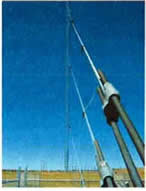
Broadcast transmission towers bring the world into our homes. Be it music, internet, cable or satellite TV/radio, all network programming originates from terrestrial or earth-based broadcast towers. And these towers are under attack!
Guyed towers, at right, are held upright by a series of cables providing lateral support, with steel shafts connecting these cables to deeply buried anchor blocks. This system works to balance these incredibly tall, yet slender structures. See figure below on left.
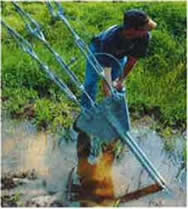 The structure itself is easily inspected for damage and maintenance issues. Unfortunately, the anchor shafts are buried several feet underground, creating a real problem for tower inspectors. Over time, corrosion, or rust, begins to attack and erode the steel shafts, compromising the stability of the tower. The structure itself is easily inspected for damage and maintenance issues. Unfortunately, the anchor shafts are buried several feet underground, creating a real problem for tower inspectors. Over time, corrosion, or rust, begins to attack and erode the steel shafts, compromising the stability of the tower. 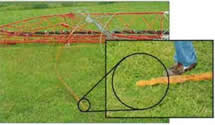
The corrosion process begins when a refined metal attempts to 'un-refine' itself, due to the electro-chemical reaction taking place. The failed tower, shown at right, is the result of a corroded anchor shaft. The picture within the picture is a close-up of the corroded shaft. Read entire article
|
| Webinars by SBE - Live and On-Demand |
Upcoming Live  Webinars Webinars
June 16 - 2:00 p.m. ET
SBE Members - $49 ∙ Non-Members - $69
Are you interested in learning what creative station engineers are doing today with FM translators and boosters? Referencing real life examples of creative translators and boosters now on the air, attendees will hear about how AM day stations can be programmed at night by using fill-in translator, translator location hopping move-ins to larger populations and translators with HD2 or HD3 primary signal inputs. Basic translator rules for NCE and commercial frequencies will be covered, in addition to how operators can optimize translator coverage. Examples of synchronous boosters that are working well today will also be provided. More Info
June 21 - 2:30 p.m. ET
SBE Members - $85 ∙ Non-Members - $125
The SBE RF Safety Course provides an overview of RF radiation issues and practices for broadcasters, including transmitter sites, SNG and ENG trucks, remote operations, biological effects of RF radiation and the distinct differences between RF radiation and ionizing radiation, FCC and OSHA regulations and more. More Info
Managing a Project and Outside Contractors for Success ∙ with John Luff
July 20 - 2:00 p.m. ET
SBE Members - $59 ∙ Non-Members - $79
This webinar will assist managers, design engineers, chief engineers and staff members planning and executing upgraded or new facilities plan effectively, and manage without undue conflict. More Info
|
|
|



