|
NACD Newsletter - Volume 5, Issue 3 - March 2012
In this issue:- "Johnny, You're So Smart!" Or Not?
- Testimonial: Arianna
- My Brain Needs Oxygen - What Can I Do?
- Product Highlight: Expand-A-Lung
- Announcements
- Upcoming Evaluation Dates
|
|
"Johnny, You're So Smart!"
Or Not?
by Vidya Guhan
|
|
 Most of us parents try to boost our children's self esteem because we want our children to be confident and see themselves as highly capable. We want them to put their best effort into any task and face challenges head-on that come their way. We want them to succeed. So it should be good for them to hear from us, their parents, that they are intelligent and talented individuals, right? Unfortunately, wrong. Most of us parents try to boost our children's self esteem because we want our children to be confident and see themselves as highly capable. We want them to put their best effort into any task and face challenges head-on that come their way. We want them to succeed. So it should be good for them to hear from us, their parents, that they are intelligent and talented individuals, right? Unfortunately, wrong.
Telling our kids that they are smart turns out to be "a not so smart" comment to make. It leads to kids having a fixed mind-set, or to believe that intelligence is something that is fixed (you have what you have) and that's it. That implies that there is nothing you can really do to improve it. Say for example, Johnny comes home with an A on a math test, and you say to Johnny, "That's awesome-you are so smart." The next time Johnny comes home with a D. Now Johnny thinks, "I must have gotten this D because I'm so dumb." Failure is daunting to a child who has a fixed mind-set, because he does not see the results as something that he can really control or do anything about, but rather a reflection of his innate intelligence, or lack thereof. In fact, research shows that individuals with a fixed mindset tend to have a futile view about effort. They believe that if they work hard at something that means that they aren't good at it, but if they don't work hard they won't do well-a real catch 22! Further, students with a fixed mindset care so much about how smart they will appear that they often reject learning opportunities-even ones that are critical to their success.
Then how do we raise kids who believe that intelligence is something they can develop? One thing we can do is to praise "effort." This time, imagine that Johnny comes home with an A in math, and you say, "That's awesome, you must have studied hard!" Should Johnny come home with a D one day, he would think, "Boy, I should have studied harder - then I could have gotten an A." And this kind of thinking is precisely what research shows that kids develop when praised for effort. They call this a growth mind-set-a belief that intelligence is a potential that can be realized through learning, or that the brain is a like a muscle that can be developed. As a result, confronting challenges, profiting from mistakes, and persevering in the face of setbacks become ways of getting smarter.
|
 |
|
 Arianna is 13 years old. She happened to have been born with one extra chromosome, a fact that is neither positive nor negative but certainly has been a challenge for her in many ways. As parents we learned that the medical term is designated Trisomy 21. We feel very strong about using that term. Verbalizing that our daughter had Down Syndrome made us feel that we were making a prophecy about her future that impeded her growing into the person she really was truly capable of becoming. Since day one Arianna has been given an empty book to write her own story (her own life). No prognosis, no predictions were made on her future. She has proved us right. Her potential keeps increasing. Arianna is 13 years old. She happened to have been born with one extra chromosome, a fact that is neither positive nor negative but certainly has been a challenge for her in many ways. As parents we learned that the medical term is designated Trisomy 21. We feel very strong about using that term. Verbalizing that our daughter had Down Syndrome made us feel that we were making a prophecy about her future that impeded her growing into the person she really was truly capable of becoming. Since day one Arianna has been given an empty book to write her own story (her own life). No prognosis, no predictions were made on her future. She has proved us right. Her potential keeps increasing.
We are a family that found NACD just after our daughter was born. She started the NACD program when she was 11 months old and continues to do program every single day.
Arianna started talking when she was 14 month old. The only difference with some other children is that within our family we speak three languages. So she absolutely had to speak, write and read in three languages: Catalan, Spanish and English. Fortunately she has never needed nor received speech therapy and functions quite well in the three different languages.
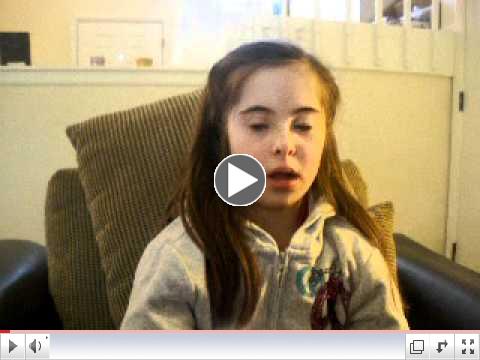 | | Arianna on YouTube |
We are originally from Spain. The education system is based on social integration so she has attended a regular school since she was 3 years old. She had support with specific areas but she never had a para-teacher assigned to her. She mainly stayed with her classmates and was pulled out of the class to work in small groups when she required assistance in specific areas. In addition to her class work she always worked with me (her mother) doing NACD's program within the school premises. During many years it was about 1 hour a day in school, and we would work with her more intensely during the weekends.
|
|
|
|
|
My Brain Needs Oxygen--What Can I Do?
by Steve Riggs, BS, RRT-NPS
|
|
 We all know that our bodies need some attention in order to grow and be healthy. We know that we need a good diet and exercise. But what about our brain? What does it need to be able to grow, to heal, and to learn in the best way it can? What are the elements of balance that will affect brain function and recovery? We all know that our bodies need some attention in order to grow and be healthy. We know that we need a good diet and exercise. But what about our brain? What does it need to be able to grow, to heal, and to learn in the best way it can? What are the elements of balance that will affect brain function and recovery?
A good diet is a great beginning. Our brain has a lot of structure just like our other body parts, and it needs to be fed well too. But there are other things that our brain needs that are less talked about. If we are going to intentionally care for our brain, we need to know about body balance in ways that we don't often hear about. Specifically, we need to do as many things as possible to get the best circulation of blood to the brain that we can. This is important because our blood carries the oxygen to our brain, and oxygen is vital to brain growth and healing. Oxygenating the brain well is required to promote brain healing and brain use. Proper brain function requires a critical balance of a) correct breathing for oxygenation b) correct carbon dioxide and nitric oxide levels for circulation and c) a program of brain activities or exercises for growth stimulation.
When we go to the doctor they often clip a piece of equipment on our finger called a pulse oximeter. It gives them a general idea of how much oxygen is in our blood. It is so important that it is often referred to as the fifth vital sign. (Vital signs are body temperature, heart rate, breathing rate, blood pressure, and now oxygen saturation.) The pulse oximeter tells them how well your blood cells are saturated with oxygen.
|
|
Expand-A-Lung
 We all know how crucial proper breathing can be to neurological function. Many children and adults have shallow breathing and poor lung capacity. This is particularly true of those who tend to breathe through their mouths. We all know how crucial proper breathing can be to neurological function. Many children and adults have shallow breathing and poor lung capacity. This is particularly true of those who tend to breathe through their mouths.
The Expand-A-Lung product, found in the NACD bookstore under "Physical Fitness," is an easy way to improve deep breathing and increase lung capacity. This device provides variable resistance levels that provide deeper breathing patterns for children and adults.
Get more oxygen. Increase alertness by improving your breathing. The Expand-A-Lung can be used while sitting in a chair, the car, or watching TV. Couldn't your child benefit from better breathing? How about you?
Order the Expand-a-Lung at the NACD Bookstore here
|
|
Whether you prefer watching videos on YouTube or listening to audio CDs in your car, don't forget about NACD's Parent Education Series. Bob Doman's informative lectures will remind you why you are doing what you are doing. The CDs make a perfect gift for teachers, grandparents, babysitters, and day care staff. Invite other families to listen too in order to help them understand why NACD is truly a different way to work with a child or to help an adult function better.

On our bookstore you will find CDs on a variety of topics, including:

On our YouTube channel you will find videos on the following topics:
Even if you've listened to these before, you'll want to listen again and again. You'll learn something new every time!
Simply Smarter Kids - Memory
Always looking for new ways to improve sequential processing and working memory? Check out NACD's iPad/iPhone app: Simply Smarter Kids-Memory.
We have found scores on Simply Smarter Kids to be comparable to reverse auditory digit spans. Since it goes up to sequences of 8, don't let the name fool you---adults love it too!
Watch for updates with expanded categories and longer sequences!

|
|
Ellen in New Jersey!
June 5-11, 2012
If you are in the New York/New Jersey area, you'll be pleased to know that Ellen Doman will be holding evaluations in your "neck of the woods" in June. Evaluations will be held in Parsippany, New Jersey and will be June 5-11. We expect these slots to fill up quickly, so call right away if you are interested in scheduling during this special event (801-621-8606).
|
UPCOMING EVALUATIONS

April 2012
Phoenix
Ogden
Philadelphia
Seattle
Cincinnati
Dallas
India
May 2012
Philadelphia
Dallas
Ogden
India
St. Louis
Bay Area, CA
Atlanta
London
June 2012
Philadelphia
Los Angeles
New Jersey
Chicago
Orlando
Milwaukee
India
Dallas
Ogden
|
NACD - The National Association for Child Development
549 25th Street - Ogden, UT 84401
801-621-8606
|
|
|
|
|
|




