 February 13 Meeting: Darryl Saffer, the Singing Videographer:
Birds of the Celery Fields, a video set to music: beautiful music, beautiful lyrics.
Social hour at 7 pm followed by our business meeting and the presentation.
First Congregational Church Fellowship Hall
1031 South Euclid Ave., Sarasota.
|
|
Christmas Bird Count Sarasota, Saturday, December 31
More than 75 counters were in the field and 12 backyard/neighborhood watchers all helped to come up with 157 species for the count (last year we had 154). The day's total of 45,229 birds was augmented by a 14,000+ Tree Swallows-last year there were 600,000 of them. They are in the area in huge numbers but they do move around. As usual, some species were up and others were down over last year. Big worries are N. Bobwhites, zero, N. Flickers, just one, two E. Meadowlarks and only 3 E. Towhees.
There were 15 teams and they pulled their weight! Teams 1 and 2 each got a Peregrine Falcon. This year, we also solved the PG mystery. Was the one that roosts on Plymouth Harbor the same one that is seen frequently on Siesta Towers? This year, by recording the exact time when each was seen, we were able to determine that there are two. Awesome!
Team 3 conjured 32 Bonaparte's Gulls out of their hats, and Team 7 obliged with a Bufflehead. Team 6 got the staked-out Whip-poor-wills-what a find-and 5 Eastern Bluebirds. Team 9 got a number of single species: Ovenbird, N. Caracara, American Pipits, Least Bittern, Hermit Thrush and Ruby-crowned Kinglet. Team 10 recorded an uncommon Yellow-throated Vireo and the only Magnificent Frigatebird, as well as the day's only E. Towhees. Team 10a got the only Wilson's Snipe and a Purple Gallinule. Also, within the Palmer Ranch complex, an early Purple Martin was spotted near a martin house. Team 12 got one of only two Purple Gallinules and 6 Redheads! Team 15 came up trumps with a Bronzed Cowbird. Team 19 got seven Horned Grebes-yes! Team 8 got the wintering Goldeneye, 3 King Rails, 4 Soras, a Sedge Wren, 2 Barn Owls, 3 Marsh Wrens and a rare Cinnamon Teal which has people from all over coming to see it. Team
11 got the day's highest count for Red-tailed Hawks-5. Team 5 pulled out 66 species as did Team 6. These two teams work in the most urbanized areas and it continues to amaze us how many species they find.
Backyard birders also contributed with the lone N. Flicker, E. Bluebirds, and 2 Ruby-throated Hummingbirds among many others species.
Thanks to all for a great day of spotting and recording.
The Thomas sisters-Glynnis Withrington and Jeanne Dubi
|
|
Special Day Trips
Carefree Learner Boat Trips
Tuesday, April 3 at 9 am
Wednesday, April 11 at 9 am
Take a private boat tour to Roberts Bay Rookery to see and learn about breeding birds.
CAREFREE LEARNER PREVIEW: Your reservation and cost will also include wine and cheese & a slide show presentation on Rookery birds on Wed. evening, Mar 28.
Contact Kathryn Young: kathwren4@gmail.com or 612-760- 1771 for RESERVATIONS and for the presentation location. Cost only $27 for all.
We still have room.
 | | Great Blue Heron with nesting material |
|
|
Bringing Florida's Gulf Coast to Life
Jeanne Dubi and the Celery Fields were featured on a Gulf Coast Journal with Jack Perkins on Thursday, January 26th at 8 PM on WEDU TV.
About the host: Jack Perkins' career as an award-winning journalist spans over 40 years, with 25 years as correspondent, commentator and anchorman at NBC News. He also served as host and narrator for many of A&E's most acclaimed programs, including the flagship series, Biography.
A resident of Casey Key, Florida, Perkins currently hosts WEDU's A Gulf Coast Journal with Jack Perkins, now in its eighth season and funded exclusively by The Gulf Coast Community Foundation.
WEDU website
|
Wakulla Springs Trip
Jan. 18 to 20
It was a good start to a fine trip. There were 40 of us, and everyone arrived at the bus on time. No latecomers, no absentees. Everyone was cheerful despite having risen so early.
Many of us had been to Wakulla before, and had not forgotten the previous trip with the bus that broke down four times and even ran out of fuel. But this bus, this bus company, and this bus driver were all different. They arrived well before the appointed time and were excellent throughout the 3 days.
We left on the dot at 7:00 while it was still dark. Then dawn brought a rainbow. A good omen. Frequent sightings on I75 kept expert birder John Ginaven and bird recorder Kathryn Young busy all the way to Paynes Prairie.
Audubon people continue to amaze. At Paynes Prairie it was raining; not just rain, but the sort that soaks, yet everyone left the bus and started looking for birds right away. One large group left at a gallop to walk the 3 mile round trip in the rain to see the Whooping Cranes. (A pity - they were not there). They did however spot a Sora. That group and the others, who did not go so far or so fast, had great sightings of White-crowned Sparrows and White-throated Sparrows. We even saw and heard a Ruby-crowned Kinglet. Busy and colorful flocks of cardinals were there too.
The rain belt faded away so it was sunny as we reached the Wakulla Springs Lodge. Karen Jensen and Jeanne Dubi had prepared well, and provided each of us with a plan of the hotel showing all the rooms with the names of the assigned occupants.

The boat ride around the spring and on the Wakulla River started at 4.15. That spring flows with a constant temperature of 70 degrees. The river there is a nature reserve and the birds are accustomed to the boats so they stayed in place to be photographed as we cruised by. The Anhingas were especially plentiful and beautiful, and there were close sightings of spectacular Wood Ducks and Hooded Mergansers. We had great sightings of a Manatee alongside the boat.

On the next day we went to the fabulous St. Marks National Wildlife Refuge. The headquarters building was the starting place and there were river otters swimming around in the lake there. We saw many types of ducks, waterfowl, shore birds and some raptors. Many of our group had a fine view of a Northern Harrier on the ground. A few saw the elusive Clapper Rail. Previous visitors had reported a Vermilion Flycatcher and a Golden Eagle and we mounted a serious search for them. They must have moved on, for even our expert birders could not find them. We had lunch at the Tallahassee Museum where one group went birding and the other went around their collection of injured animals and birds. This turned out to be a little jewel. Extremely interesting with good views of a bobcat and a Florida panther
That evening, as on both evenings at the Lodge, we were entertained by expert pianist Bruce Higgins, one of our group who gave up socializing for a lonely time at the piano keyboard.The Lodge had its troubles, caused by new owners, and willing, but not too competent, new staff. Jeanne and Karen gave the new staff an education, insisted on different dining rooms, changed the way the food was served, and pitched in to help speed the line.
On our last day we went north to the Georgia border and visited "Tall Timbers", a research station concentrating on the ecology of fire and natural resource management. It turned out to be the most interesting part of the trip for me. We mounted trailers with benches and were towed around the reserve by an enthusiastic researcher and his assistants.

There are some good birders and Audubon members who believe the Red cockaded Woodpecker might be a myth, for they have never seen one. That morning at Tall Timbers we saw three Red-cockaded Woodpeckers, one above the other on the side of a tree. Really good views of a rare and elusive bird. We also saw Brown-headed Nuthatches and a hard to find Sedge Wren.To add even more spice to our trip the researcher put up a net, caught a Bachman's Sparrow, and then banded it.

After that we had our picnic lunch and drove home without incident. Throughout the journey John Ginaven searched for birds he felt that we should have seen in addition to the exotic 125 species that we did see. Amazingly our list lacked a House Sparrow, and we wanted to add Tree Swallows and a meadowlark, but they were not to be seen.
Throughout the trip Jeanne and Karen put in enormous efforts to make us comfortable, well fed and nurtured, and kept us on time. They organized the trip with much careful planning and continuous effort. They kept us well supplied with drinks and snacks. They had the ability to make each one of us feel special, and worked hard to make sure we all enjoyed the experience. Yes, it was a fine trip.
Ron Platt
Trip Recorder
|
Special Sighting
Cinnamon Teal have been seen in the Celery Fields the past several weeks.
Mark Vance has a lovely video of these visitors usually found in the West.
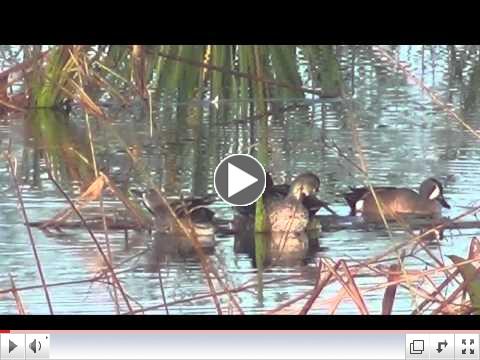 | | Cinnamon Teal Far From Home |
|
Reddish Egrets in Decline
I am gathering information from Ann Paul (Audubon of Florida) on our rookery birds here in Florida for some upcoming Audubon presentations. Here is what she had to say about the Reddish Egret when I asked about the numbers. I do not think most people know this. Actually, the number is much less, with probably only about 350-375 nesting pairs in Florida and perhaps only 2,500-5,000 pairs in the world.
 | | Reddish Egret by Rick Greenspun |
Most nesting in the US is in Texas, with FL having the second most nesting pairs. They also nest in Mexico, Cuba, Bahamas, Caribbean islands, Central America and perhaps northern South America. There is a nesting population in Merritt Island NWR (Haulover Canal Spoil Island and Tank Island) and some nesting near New Smyrna Beach, but nesting has centered mostly in Florida Bay since the late 1930s and Tampa Bay since the mid 1970s.
|
SAS Name Badges
Send name and address to:
Michael Fox, 2749 Ringling Ave., Sarasota, FL 34237 $4.75 with pin & $6.75 with magnet Add $2.00 for shipping
|
|
Key West and Dry Tortugas
April 16-19 2012
We will travel to popular Key West, stop at the Ten Thousand Island tower on the way there, stay at the Comfort Inn and the next day take the commodious Yankee Freedom to spend the day at historic Fort Jefferson on the Dry Tortugas. The Dry Tortugas are a respite for migratory birds returning from South America. We expect to see nesting Sooty Terns, Brown Boobies, various warblers and many other varieties.
The third day the bus will take us to hot spots around Key West, the lower keys, and the Wild Bird Rescue Center. A few of our target birds are the White-crowned pigeon, Mangrove cuckoo and Wurdemenn's heron. Each evening we'll search for the Antillean nighthawk. On our return north the fourth day we'll stop off at Pennekamp State Park and take a glass bottomed boat ride. From there we'll bird our way back with a late arrival in Venice/Sarasota. We are hoping to see 100+ species. The cost is $600 pp dbl/$800 single and includes bus, motel, all entry fees, boat rides, and tips. All meals are included except the evening meal. Charlie Sample will be our bird guide. For more information please contact: Charlie Sample, 497-6463 or Karen Jensen, 924-2446 Sponsored by Venice Audubon and Sarasota Audubon Societies
|
Subscribe to Bird Alerts!
Need the latest birding info for our area? To subscribe, just send an e-mail. Thanks to Peter Rice for providing this service.
|
|
Upcoming Events
Thursdays, Feb. 2, 9, 16, 23: OSCAR SCHERER STATE PARK
Every Thursday, Oct thru Apr. Join a bird walk to search for Florida Scrub Jays, N. Bobwhites, and other pine flatwood species. Meet inside the park at 8:30am at Lake Osprey/Nature Center (park fee). Call Joyce with questions (508-737-8954)
Saturday, Feb. 11: CELERY FIELDS BIRD WALK
Meet at the gazebo (Palmer & Raymond)
for an 8am bird walk.
Tuesday, Feb. 14: CELERY FIELDS Clean Up
Meet at the gazebo (Palmer & Raymond) at 8am.Gloves, vest, rakes supplied.The more volunteers, the sooner we're done. Please give us an hour of your time.
Tuesday, Feb 14: FT. DESOTO SHOREBIRDS & DUCKS
Join Lynn Jakubowicz, 355-4073 and Mary Heinlen to find these beautiful migrating birds. Meet at Starbucks (University & I-75 next to Home Depot) at 7:30am. BRING LUNCH.
Saturday, Feb 25: BIRD SONGS, CALLS AND PLANT WALK with David Williamson (302-1808).
Join us as we walk thru Urfer Park, one of Sarasota's newest parks. David will help you to ID birds by their calls/songs before they make an appearance. He will also help us to ID many native plants. Meet at Urfer Park, Bee Ridge and Honore, at 8am.
Monday, Feb 27: CELERY FIELDS MONDAY BIRD WALK CLUB
Joyce Leary (508-737-8954) leads a bird walk every 4th Monday, Oct thru March at the Celery Fields. Meet at the gazebo (Palmer & Raymond) at 8am.
Thursdays, Mar 1, 8, 15, 22, 29: OSCAR SCHERER STATE PARK
See beginning of TRIPS for details.
Tuesday, Mar 6: FELTS PRESERVE
Help Dan Irizarry (305-582-5786) find Painted Buntings and more. Meet at Felts Preserve at 8am
 | | Painted Bunting |
Wednesday, Mar 7: VENICE ROOKERY & SHAMROCK PARK
Join Stu Hills (922-5261) and Martha Straub at Shamrock Park in south Venice along the Intracoastal Waterway as they look for waterbirds, scrub-jays, and gopher tortoises, then on to the Venice Rookery. Meet 8am at McDonalds (Bee Ridge & Cattlemen). BRING LUNCH.
See our new website www.sarasotaaudubon.org for detailed directions to all day trips and activities.
|
| Local Membership
To receive your newsletter electronically, send an email to: membership@sarasotaaudubon.org with your request. Printing/mailing costs can be allocated to other projects with your help. To view our electronic version, click here, go to "News" and then "Brown Pelican."
Last chance to pay your 2012 SAS dues!! All local SAS memberships for 2012 are now due. For only $20 a year, you help underwrite our printing, postage, and meeting place expenses. You can renew online at our new website or you can mail your $20 to:
SAS (Membership),
PO Box 52132, Sarasota, FL 34232
Lynn Jakubowicz, Membership Chair
|
In the Field
Circle B Bar Reserve
1/18/12
Eighteen birders gathered this morning just as the sun was rising, for the trip to Circle B Bar Reserve, lead by Lynn Jakubowicz and Mary Heinlen. The day turned out to sunny, warm and breezy.
One of the early highlights of the trip was finding five Purple Gallinules and three Soras, all sharing the same small shallow pond. We were treated to close views as the birds fed, seemingly oblivious to our presence only a few yards away. We also saw plenty of ducks, including Mottled, Ring-necked, American Wigeon, Blue-winged Teal, Gadwall, Northern Shovelers and Black-bellied Whistling ducks, although by far the most numerous birds on the water were the hundreds of American Coots. But the bird of the day was clearly the Horned Grebe seen near the end of our trip
After our walk we adjourned to the picnic area for lunch and tallied up our bird list, coming to a total of 59 species for a great day.
Mary Heinlen.
1/28/12We had great birding today on our trip to parks in Hillsborough County, led by Lynn Jakubowicz and Mary Heinlen. We visited two of the county's Wilderness Parks, both set along the Hillsborough River. We started the day at Morris Bridge Park, which lived up to it's reputation as a spot where the birding starts the minute you step out of the car. We birded the oaks and palms around the parking area for almost an hour, getting close up views of Carolina Chickadees, Ruby-crowned Kinglets, Yellow-throated and Black and White Warblers, Tufted Titmouse, Northern Parula and Blue-headed Vireo. Our visiting birder from Seattle was thrilled by a singing male Northern Cardinal perched in full view on a sun lit branch. It made us all remember just how beautiful some of our common species really are.  We then moved on to the boardwalk leading to the river. We saw four species of woodpecker, including a very bright male Yellow-bellied Sapsucker hanging almost upside down eating berries from a vine only a few feet from the boardwalk. But the bird of the day was a Northern Waterthrush found by a member of our group from Louisiana. After Morris Bridge, we went on to Trout Creek Park for more birding, including Wilson's Snipe and nest building Ospreys, followed by a picnic lunch. Mary Heinlen
|
Birding on the Suncoast
with SAS' Stu Hills - ABC 7 News
Stu did an excellent commentary on birding in Sarasota and its economic impact on our community.
|
|
History of the Celery Fields-Part 2
Saving the Celery Fields
The Celery Fields that birders flock to today was indeed, for a long time, a place to grow celery. In 1910, Bertha Palmer, a wealthy widow from Chicago, arrived in what is now Sarasota County and purchased 90,000 acres of property, including the area now known as Selby Gardens, and areas as far south as Spanish Point. Twenty-five thousand acres were destined for ranching and agriculture; that acreage included 300-400 acres south of I-75, known to us now as the Celery Fields. These acres were drained and cleared for agriculture by Bertha Palmer's sons in the 1920s. As described in Arny Rawson's 2002 report (Part 1 of this series), the swampland muck was rich in nutrients, and ideal for growing celery. The canals constructed for drainage provided water for irrigation. Sarasota eventually became the largest producer of celery in Florida, and the 7th largest in the country.
By 1972, the land had passed to the Ferlise family, owners of FanCee Farms, and it continued producing celery for many years. In 1992, a 3-day rain dropped 22 inches of rain in the area and more than 200 homes that had been built in the vicinity were flooded. Sarasota County recognized that it was necessary to find means to control this flooding, and the Phillippi Creek Basin Master Plan was created. The Celery Fields' component of the plan began with the 1995 purchase of the land and the design of a system to retain flood waters and mechanisms to permit the slow release of the flow downstream to Phillippi Creek. A later document (FEMA, 2007) describes the construction as incorporating the existing canal infrastructure, with added diversion gates, outflow pipes, and mechanical controls. A wetland restoration area was included, to improve the quality of the water flowing into the creek. The resultant complex of ponds and marshes made the area more attractive to birds. And to birders: Sarasota Audubon Society (SAS) archives show increasing interest in Ackerman Park and "the surrounding area" in "Birding Close to Home" field trips, among others.
The flood control methods established in 1995 were thought to be effective at the time. However, in September 2000, a County-commissioned engineering analysis described the Celery Fields water retention system as inadequate to meet newly-estimated flood control needs. Modifications of existing permits were proposed to "relocate the required wetland mitigation off-site". Assuming
r
etention ponds would be located elsewhere, "improvements" proposed for the Celery Fields at that time included soccer fields, a model boat racers' facility, and "typical park shelter". That proposal, and others in play at the time, caused concern among many environmentally-sensitive groups. The Sarasota Herald Tribune (September 2002), in an article entitled "Feathers Ruffled over Plans for Park", stated "The 300 acre area of intermingled ponds east of Interstate 75 has become one of the hot spots in Florida's booming birding industry. The county wants to build paved hiking trails and picnic facilities at the site, concerning bird-watchers."
Birdwatchers were already concerned. The SAS effort to secure the Celery Fields for wildlife habitat actually began a year previously. Starting in January 2001, Jeanne Dubi, and other SAS volunteers, carried out a year-long survey of bird sightings in the Celery Fields, spotting 123 species. In March, 2002, the SAS Board of Directors (Julie Byrne, President; with Carolyn Primus, Wade Matthews, Debbie Dixon, Sara King and Rusty Blackwell), created a committee to pursue the Society's "Celery Fields Project". The committee was chaired by Jeanne Dubi and included Wade Matthews, John Ginaven, Arny Rawson, Jo Wieczynski, Bill Lewis (Sierra Club), and Owen Comora. The aim of the committee members was to gather essential information on all aspects of the subject, and to initiate contact with the various departments of Sarasota County that had responsibilities in the Celery Fields. Contacts were made with Sarasota County Public Works, SWFWMD, the Department of Parks & Recreation, and Environmental Services.
A document entitled "The Sarasota Celery Fields---An Outstanding Natural Resource"" was prepared by SAS and sent to the appropriate County offices. In this document, SAS made a persuasive argument that, along with its flood mitigation role, the Celery Fields provided habitat for wildlife that was important in its own right, but that also represented an ecotourism destination of significant economic value. A "Current Problems: Future Solutions" section was included. The members of the SAS Celery Fields Project Committee worked tirelessly through that spring and summer, addressing some of the immediate problems (e.g., excess mowing of fields, lighting fixtures that were too high and too bright, etc.), and attempting to gain cooperation from the County for long-term planning that assured protection of the habitat. SAS records contain responses from some of the County offices and Commissioners that appeared to offer encouragement
However, on September 10, 2002, a public meeting was held by the County, and a plan was unveiled to "build recreational amenities.....including hiking trails, picnic facilities, fishing piers, and canoe and kayak trails."(Sarasota Herald Tribune, September 2002). Critics of the plan, including SAS, the Sierra Club, and other interested community members, objected strongly, prompting the Tribune to state: "Tuesday's opposition may have swayed the county's thinking".
SAS followed up with a document titled "Reactions and Further Suggestions to the 9/10/02 Public Meeting Re: Celery Fields". Here is the opening paragraph:
"The Celery Fields' two major purposes are: 1) Flood easement, and 2) Wetlands mitigation, as mandated by SWFWMD and the Army Corps of Engineers, providing for diverse wildlife habitat. The task of flood easement has been accomplished, and the wetlands mitigation phase will be completed after the wetlands development of the South Cell (south of Palmer Boulevard). Adhering to these 2 objectives is all that is required to enhance wildlife. Any other enhancements for general use will seriously degrade the site for wildlife." SAS goes on to say in this document that wetlands development in the South Cell must reflect a marshland/wetland environment, with careful attention to plantings.
Supporting the economic value of the Celery Fields, the point is made that Corkscrew Swamp Sanctuary brings $9.4 million in visitor dollars to Collier County, and improvements to the Celery Fields habitat would allow for it to be included on the Great Florida Birding Trail, a potential economic boon to Sarasota County.
What follows in that document is a comprehensive list of suggestions and recommendations that influenced developments during the next eight years, culminating in the Grand Opening of the Celery Fields Park in May, 2011.
Jane Brandhorst, Historian
|
Be a Volunteer
One of the reasons we are a growing and successful organization is our volunt eers. SAS is non-profit and volunteer driven. You could be a part of our exciting future. Please share your talents. eers. SAS is non-profit and volunteer driven. You could be a part of our exciting future. Please share your talents.
Contact:
VolunteerCoordinator, Marcy Packert
volunteer@sarasotaaudubon.org or 360-0808
|
|



