|
Piezo Actuators Multilayer, Stack, Bending, Stripe
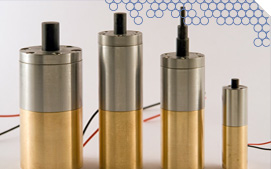
A piezo actuator converts an electrical signal into a precisely controlled physical displacement, to finely adjust precision machining tools, lenses, or mirrors. Piezoelectric actuators also are used to control hydraulic valves, act as small-volume pumps or special-purpose motors, and in other applications. Piezoelectric motors are unaffected by energy efficiency losses that limit the miniaturization of electromagnetic motors, and have been constructed to sizes of less than 1 cm3. A potentially important additional advantage to piezoelectric motors is the absence of electromagnetic noise.
There are two different types of piezo actuators / piezo multilayers. The first is a stack actuator. A stack actuator is constructed in one of two ways: discrete stacking or co-firing depending on the user's requirements. The other type of piezo actuator is a stripe actuator or bending actuator, in which thin layers of piezoelectric ceramics are bonded together; the thin layers allow the actuator to bend with a greater deflection but a lower blocking force than a stack actuator. Alternatively, if physical displacement is prevented, a piezo actuator will develop a usable force. Review Resources for Piezo Stack ActuatorsExplore details about Piezo Benders Learn more about Stripe ActuatorsWant to review a project or product with an APC International Representative? Contact Us!Have Specifics and a Drawing? Request a QUOTE | |
| | |  | |
|
|
|
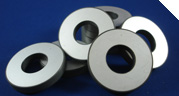
SALE ITEMS - New selection of rings added!
Low Prices and Ready to Ship
- Discs, Rings and Plates
- Disc Benders
- Actuators
- Air Transducers
QUICK DELIVERY! Perfect for experimentation, samples, or small projects.
|
|

| | |
| |
| |
|
|
Understanding Piezo Element Behavior
What parameters matter?
A piezoelectric ceramic element exposed to an alternating electric field changes dimensions cyclically, at the frequency of the field. The frequency at which the element vibrates most readily in response to the electrical input, and most efficiently converts the electrical energy input into mechanical energy -- the resonance frequency -- is determined by the composition of the ceramic material and by the shape and volume of the element.
As the frequency of cycling is increased, the element's oscillations first approach a frequency at which impedance is minimum (maximum admittance). This frequency also is the resonance frequency. As the frequency is further increased, impedance increases to a maximum (minimum admittance), which also is the anti-resonance frequency. These frequencies are determined by experiment - to see how, refer to Determining Resonance Frequency.
The values for minimum impedance frequency and maximum impedance frequency can be used to calculate the electromechanical coupling factor, k, an indicator of the effectiveness with which a piezoelectric material converts electrical energy into mechanical energy or mechanical energy into electrical energy. k depends on the mode of vibration and the shape of the ceramic element. Dielectric losses and mechanical losses also affect the efficiency of energy conversion. Dielectric losses usually are more significant than mechanical losses.
Review functions, formulas and additional details
Preview or Order Piezoelectric Ceramics: Principles and Applications on Amazon.com | |
Relevant Behaviors Reviewed:
- Applied Force related to Charge produced
- Applied Voltage related to physical dimensions
- Stability
- Electrical Limitations
- Thermal Limitations

 | |
| | |
|
|
|
UPCOMING EVENTS
| |
| |
| |
| |
|
SPIE Smart Structures / NDE Exhibition 2012
When: March 11-15, 2012
Where: Town and Country resort and Convention Center, San Diego, California, USA
Event Info: A multidisciplinary forum that seeks to advance research in adaptive structures and mechanisms, smart sensors, NDE, civil infrastructure, aerospace systems, energy harvesting and more.
Learn more about the event!
Review what happened at the exhibition last year.
| | |  |
|  | | |
|
|
|
Ultrasonic Industry Association 41st Annual Symposium
When: April 16-18, 2012
Where: Mark Hopkins Hotel, San Francisco, CA, USA
Event Info:
This is a well rounded forum for users, manufacturers and researchers to discuss state-of-the-art materials and devices to generate, detect and suppress sound. Papers will be presented and commercial firms may also display and/or present products.
Additional event information here
Call for Papers - Due Nov 18, 2011
Call for Posters - Due March 16, 2012
| |

|
|
| |
| | |
| | | |
|
|
|
3rd International Symposium: MR-guided Focused Ultrasound 2012
When: October 14-17, 2012
Where: Washington, DC Metro Area, USA
Event Info:
Targeted to scientists, clinicians and others interested in current and future applications of MR-guided focused ultrasound, the conference will offer a multifaceted exploration of this emerging field and feature plenary sessions, panel discussions, poster presentations and technical exhibits.
Symposium topics include:
- MR-guided focused ultrasound technology
- Brain, Prostate, Breast and Liver applications
- Back and neck pain, other applications
- Bone tumors & Uterine fibroids
- Focused ultrasound-mediated drug delivery
- Late-breaking Research
- Accelerating Development & Adoption
Additional event information here
Focused Ultrasound Surgery Foundation
Resources from the 2010 Symposium
Other Related Conferences
| |


|
|
| |
| | |
| | | |
|
|
|
|
|
|