| Tipped: The UNEP FI 13th Global Roundtable |
With economic recovery topping the United States and global political agenda, a group of CEOs, major investors and bankers together with former United Kingdom Prime Minister Gordon Brown and President of Ireland Mary Robinson called for a far-reaching reform of the global financial system at the UNEP FI Global Roundtable in Washington D.C. late last month.
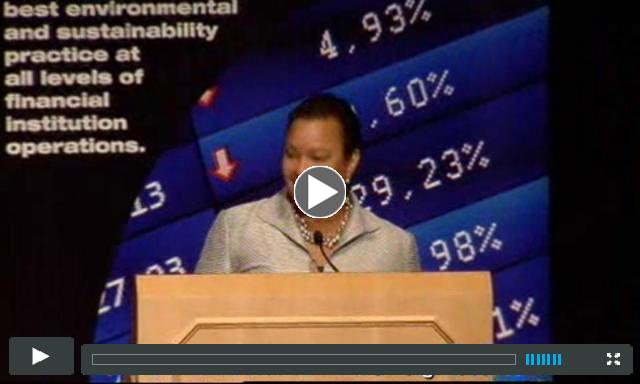 | |
Global Roundtable opening session
|
Amid a growing wave of protests highlighting economic concerns in countries from the US to the UK, Japan and Greece, more than 500 senior finance executives and policy-makers from around the world met at the summit to find sustainable solutions to tackle the drivers of market volatility and address the deepening rift between the rich and the poor.
"Clearly the financial world must do its part in creating mechanisms that lead to a more equitable and green economy. The set of proposals put forward during the Global Roundtable are a politically credible and economically sound roadmap to achieve this goal. The outcomes of the Roundtable are indeed very timely, as it offers various solutions to the 99 percent who feel marginalized by the current economic system," said Mary Robinson, the former President of Ireland, at the event. 
Recommendations included the implementation of policies that can mobilize investment at scale by the banking and investment sectors into emerging industries associated with sustainability - including the clean energy sector, renewable energy, green buildings and retrofitting, clean vehicles and fuels.
The summit's participants stressed that with the right incentives in place private finance can play an essential role in spurring a recovery of the US economy and achieve job-creation in sectors ranging from green technology to ecosystem management.
More information and video recordings of the Global Roundtable here.
|
| Bridging the public-private divide on climate change at UNFCCC Conference of Parties, Durban, South Africa |
 The private financial sector has to be a central part of the global strategy to address climate change. Not only do financial institutions possess the skills, expertise and resources required to deal with the problem: if the private sector broadly, and the financial markets in particular, do not become a part of the solution to climate change, they are likely to remain a part of the problem. Yet, these skills, resources and expertise - as well as the policy means to unlock them for good - are seldomly considered and discussed in the international negotiations on climate change, and banks, insurers and investors have remained on the sidelines. The private financial sector has to be a central part of the global strategy to address climate change. Not only do financial institutions possess the skills, expertise and resources required to deal with the problem: if the private sector broadly, and the financial markets in particular, do not become a part of the solution to climate change, they are likely to remain a part of the problem. Yet, these skills, resources and expertise - as well as the policy means to unlock them for good - are seldomly considered and discussed in the international negotiations on climate change, and banks, insurers and investors have remained on the sidelines.
The members of UNEP Finance Initiative are changing this by bringing their core expertise, in a structured and continuous manner, to the intergovernmental climate process on those specific issues where their focused input is most direly needed:
- Designing a Green Climate Fund which is effective in unlocking private investment for low-carbon and climate-resilient growth in developing countries;
- Mobilising the risk management skills of the insurance industry to address loss and damage from the impacts of climate change;
- Building an effective global funding mechanism for forest-based climate change mitigation.
More information here.
|
|
New handbook on banking and sustainability offers guidance
| |
Launched at Global Roundtable on 19-20 October 2011 in Washington D.C., the UNEP FI Guide to Banking and Sustainability provides a clause-by-clause explanation of the UNEP Statement of Commitment by Financial Institutions on Sustainable Development.

The Guide seeks both to shed further light on the meaning of individual clauses, and to provide guidance on how banking institutions might seek to apply them in their day-to-day operations across different departments. It further provides illustrations of current practice within UNEP FI Signatory banks, and references to key resources. The majority of UNEP FI's 200-plus members are banking institutions.
More information here.
|
|
World's largest investors step up call for policy action on climate change
|
Marred by the global economic crisis, the world's largest investors late last month urged governments and international policy makers to take new and meaningful steps in the fight against climate change, cognizant that unabated climate change will lead to economic damage several times the size of current turmoil.

In a joint statement the group of 285 investors representing more than $20 trillion in assets, stressed the urgent need for policy action which stimulates private sector investment into climate change solutions, creates jobs, and is essential for ensuring the long-term sustainability and stability of the world economic system.
Investor support for climate action has nearly doubled since November 2008, when 150 investors with $9 trillion in assets under management first came together to urge government leaders to act on climate change.
The statement is supported by the findings of a report, Investment-grade Climate Change Policy commissioned by the three investor groups and UNEP FI. This report underscores the importance of investment-grade policy which will enable institutional investors to allocate capital towards climate change solutions, including appropriate government incentives to compensate for heightened risk and sufficient scale of technology deployment.
"Governments have clearly signaled their intention to move towards a low-carbon future. To get there fast enough will require huge new investments in clean energy. This is the only way to guarantee the long-term sustainability and security of the world economic system and the stability of returns from global investment, a major part of which is directly linked to the pensions and life insurance of ordinary people around the world. This global investor group has seen this clearly," said Christiana Figueres, Executive Secretary of the United Nations Framework Convention on Climate Change (UNFCCC).
|
|
Latest benchmarking study on the extractive sector
| |
 The Natural Value Initiative (NVI) - a collaboration between UNEP Finance Initiative, Dutch social investment NGO VBDO and international environmental group Fauna & Flora International - launched a benchmarking report of the management of biodiversity and ecosystem services within 30 companies in the mining and energy sectors. It repeats and updates a similar analysis conducted in 2005. The Natural Value Initiative (NVI) - a collaboration between UNEP Finance Initiative, Dutch social investment NGO VBDO and international environmental group Fauna & Flora International - launched a benchmarking report of the management of biodiversity and ecosystem services within 30 companies in the mining and energy sectors. It repeats and updates a similar analysis conducted in 2005.
The report, Tread Lightly, outlines the significance of this issue for the extractive industry, the status of integration at present and what companies and investors can do to better integrate it in their operations and decision-making.
The extractive sector faces increasingly material risks from biodiversity issues with some companies taking a clear lead over others in addressing these risks. Companies that manage this issue proactively, and those that invest in them, are likely to realise competitive advantage in the future linked to better management of reputational, operational and financing risks.
More information here.
|
| New framework for government bonds aims to incorporate ecological factors |
Could an abundance of natural wealth be a factor in positively influencing a country's credit rating and the quality of its bonds? Could a resource-guzzling economy be cause for a downgrade?
Earlier this month, UNEP FI in collaboration with the Global Footprint Network, an international sustainability think tank, and leading financial institutions, launched an endeavor to shine a light on these question with the launch a groundbreaking project to explore the role of natural resource accounting in strengthening risk models for government bonds.
The government bonds project has two aims: it will investigate the linkages between ecological risk and country-level risk in sovereign bonds, and develop a methodology to explore how credit rating agencies, investors and financial information providers can integrate ecological data into their respective models. In particular, the analysis will look at the risks to countries whose populations and/or industries require more resources than is domestically available and which are hence reliant on ecological services from abroad.
Paul Clements-Hunt, head of UNEP FI said: "The global financial crisis has taught us more than anything that some of the core risks that affect the value of debt securities and derivatives can simply run ahead of our ability to understand them. This is why we must deepen our understanding of the risks posed by climate change, water scarcity and the overuse of natural resources for securities. We should not be caught off-guard again. This project is one of the first that tries to quantitatively and systematically consider the linkages between the use of natural resources and its impact on a country's core economic indicators that in turn influence the quality of its bonds."
More information here.
|
New report shines light on environmental employee engagement worldwide
| |
Launched at the UNEP FI Washington D.C. Global Roundtable late last month, the UNEP FI North American Task Force shines a light on the state of environmental employee engagement worldwide with the publication of part II of its report series If You Ask Us... Making Environmental Employee Engagement.

According to the briefing's findings, which builds upon a survey conducted worldwide with UNEP FI members in 2010, the vast majority of financial institutions do promote Environmental Employee Engagement (EEE) within their organization, suggesting that the practice has made significant strides not only in North America, as was concluded in the series' first part, but also across the globe.
While institutions seeking to implement EEE have explored internal environmental management opportunities, notes the report, a few financial institutions have also successfully integrated the framework into their mainstream business strategies. The survey's results finally offer valuable insight on best practices and challenges ahead in environmental employee engagement. The survey's results are based on data collected among 73 respondents, all UNEP FI members.
More information here.
|
UNEP FI Principles for Sustainable Insurance consultation lands in Europe
| |
The pioneering global process to develop Principles for Sustainable Insurance (UNEP FI PSI) reached its penultimate region in October.
Munich Re, one of the world's leading reinsurers, hosted the European consultation at their headquarters in Munich, Germany. The event convened insurance industry leaders and stakeholders, including delegates from the European Insurance & Occupational Pensions Authority, European Insurance & Reinsurance Federation, The Geneva Association, Standard & Poor's, WWF and academia.
The event, which ran from 25 to 26 October, was led by Munich Re's CEO, Dr Nikolaus von Bomhard, and moderated by Dr Astrid Zwick, Munich Re's Head of Corporate Responsibility and Chair of UNEP FI's Insurance Commission. UNEP was represented by Sylvie Lemmet, Director of UNEP's Division of Technology, Industry & Economics; Paul Clements-Hunt, Head of UNEP FI; and Butch Bacani, Programme Leader of UNEP FI PSI & Insurance Commission.
Europe was the sixth leg of the global consultation process, with Asia being the final destination. The Asian gathering will take place from 10 to 11 November in Tokyo, Japan. It will be hosted by Tokio Marine & Nichido Fire Insurance and is supported by Mitsui Sumitomo Insurance, Sompo Japan Insurance and the General Insurance Association of Japan.
UNEP FI will launch the Principles for Sustainable Insurance at the 2012 UN Conference on Sustainable Development in Rio de Janeiro, Brazil as a landmark contribution and long-term commitment of the insurance industry to building a sustainable global economy.
More information here.
|
| Colombian sustainability committee comes into being with help of UNEP FI |
The sustainable finance agenda will receive a major push in Colombia this coming December with the creation of a unique body within the Colombian Banking Association tasked with addressing sustainability issues.
The Sustainability Committee, prompted by a tripartite dialogue between UNEP FI, Colombian banking association Asobancaria and Colombian authorities, will be a first in Colombia. It is modeled on similar initiatives that have successfully created comparable platforms in Brazil, South Africa and a handful of other countries in recent years.
The body will be constituted of representatives from a kaleidoscope of Colombian banks - including Bancolombia, Bancoldex and Helm Bank.
It will endeavor to catalyze the mainstreaming of environmental and social aspects of risk analysis across the country, green services and products opportunities, and eco-efficiency through high-level discussions and information-sharing activities.
To kick-start this ambitious program of work, the Colombian Banking Association will host an environmental social risk analysis introductory workshop in Bogota on 2 December.
Confirmed participants include risk, credit and sustainability managers from banks countrywide as well as delegates from the Colombian presidency, the Environment Ministry and regulators from the country's financial supervisory body.
The Sustainability Committee stems from the recent signing of an agreement between the Colombian Banking Association and UNEP FI.
More information: la [at] unepfi.org
|
|
UNEP FI and PRI joint webinar: "Property investors' perspective on Climate Change policy," 17 November
| |
The bulk of GHG emissions attributable to buildings emanate from the existing stock. To achieve energy saving and emissions reduction targets in the EU, US and elsewhere, a coherent set of polices is needed to drive responsible behaviors across key stakeholders and over the life-cycle of buildings.
This webinar will review the following important issues, namely:
- What measures can be introduced to drive mutually reinforcing and responsible behaviors in property investors and managers, brokers and occupiers over the whole life cycle of buildings?
- Which of these measures have to date proven most successful and which are the most cost-effective?
- What is the potential for using market-based mechanisms like 'carbon trading schemes' in driving responsible behaviors?
- What role can labelling and metrics play in the policy agenda and what measures can be adopted to accelerate standardization, consistency and comprehensiveness of environmental metrics, labels and standards for buildings?
Confirmed speakers are:
- Tatiana Bosteel, Head of Sustainability, Hermes Real Estate
- Sarah Turner, Strategic Advisor, Sustainability Solutions, Lend Lease
Guests are invited to attend the webinar on 17 November at 10.00 am (CET).
More information and registration here or at property [at] unepfi.org.
|
Banco General latest to adhere to UNEP FI sustainability statement
| 
Panamean bank Banco General became the first institution in the country to join the ranks of UNEP FI late last month. The bank's membership, initially formalized in Panama, was confirmed during a signing ceremony organized on the sidelines of the UNEP FI 2011 Global Roundtable summit.
"We are very proud to become part of this coalition as we seek to align our financial operations with sustainability. As a socially responsible company we are committed to achieving this goal," said Banco General's executive vice-president and general manager Raúl Alemán Zubieta.
"Latin America's commitment to the notion of sustainable finance has made a giant leap over the last years. We are delighted that Banco General will be the standard bearer for sustainability among other Panamean financial institutions, and salute the vision Banco General has displayed in taking up that role," added UNEP FI's head Paul Clements-Hunt.
More information here.
|
|
| UNEP FI to speak at FELABAN Annual Assembly, Miami, 13-15 November |
UNEP FI is to address heads of Latin American banks during the XLV edition of the Latin American Federation of Banks (FELABAN) Annual Assembly slated to take place in Miami, USA.
The FELABAN Assembly, organized in cooperation with the Florida International Bankers Association, attracts over 2,000 bankers from more than 50 countries who wish to meet and do business with their international counterparts from Latin America, United States, Canada, Europe and Asia.
The meeting's high point is the Governing Council, at which presidents of national banking associations and CEOs of the region's major banks take stock of latest trends and challenges their industry faces - including the preliminary results of a far-reaching UNEP FI-led survey on sustainability in Latin America.
UNEP FI member banks, including BBVA Group and Bancolombia, will also share their experiences in a discussion panel taking place on 14 November.
In a landmark agreement between UNEP FI and FELABAN signed earlier this year, the two organisations agreed to vie to step up efforts towards the implementation of sustainability in Latin America in the years to come.
More information here.
|
| CalPERS steps up the ESG integration drive across all asset classes | |
On 15 August, CalPERS Investment Committee held a workshop to examine how best to integrate environmental, social and governance (ESG) factors into the Pension Fund's investment process in order to enhance risk management.
For the past year, the CalPERS Investment Office has been developing a comprehensive plan to implement ESG into investment decision-making across all asset classes. During the workshop, CalPERS Investment Office gained Board input on priorities and the development of an ESG integration plan.
More information here.
|
Calling FI's to join the Investors Group of the International Integrated Reporting Committee's Piloting Programme
| |
The IIRC has established a Pilot Programme that explores Integrated Reporting in a corporate culture. Participation in the Integrated Reporting Pilot Programme offers a select group of companies the opportunity to demonstrate global leadership in this emerging field of corporate reporting. Through the Pilot Programme, the principles and practicalities of Integrated Reporting will be tried and tested, with the intention to create a new global standard in Integrated Reporting.
The aim of Integrated Reporting is to demonstrate the linkages between an organization's strategy, governance and financial performance and the social, environmental and economic context within which it operates. The IIRC's Framework will support an organization in addressing, in a clear and concise manner, the material issues affecting its ability to create and sustain value in the short, medium and longer term.
The Pilot Programme is a platform for companies to start applying the principles of Integrated Reporting, as champions of reporting innovation.
More information here or at joris [at] theiirc.org.
|
| CASBEE releases tool on green property financing | |
The CASBEE for Market Promotion comes after a recent call by the UNEP FI Property Working Group to bridge the gap that separates financial and environmental experts and move the dialogue on environmental metrics for property investment forward.
More information here.
|
|
|
|
Upcoming training
| |
English:
7-25 November
The Environmental and Social Risk Analysis (ESRA) Online Course runs interactively over a three-week period and is intended specifically for risk managers and analysts in commercial, corporate, investment and retail banking in or dealing with developing countries and emerging markets.
More information here.
***
English:
7 - 28 November
The Climate Change: Risks and Opportunities for the Finance Sector Online Course aims to equip financial institution executives and stakeholders with fundamental knowledge on a variety of aspects at the interface of private finance, climate change, and climate regulation, as well as to provide support for the development of effective responses.
| |
|
|
|



