March is National Colorectal Cancer Awareness Month 
Colorectal cancer is the second most commonly diagnosed cancer in New Hampshire. An estimated 730 people will be diagnosed with colorectal cancer and 220 people will die this year. According to the CDC, the number of new colorectal cancer cases could be reduced by as much as 90% if all precancerous polyps are identified by screening tests and removed before they become cancerous.
Read more...
|
Upcoming Events 3/30/12: Colorectal Cancer Screening Expo 11am - 2pm Dartmouth- Hitchcock Medical Center, Maine Entrance, South Mall, Fuller Board Room, One Medical Center Dr., Lebanon, NH FMI: Click Here
--- 4/16/12: National Healthcare Decisions Day National Healthcare Decisions Day is an initiative to encourage patients to express their wishes regarding healthcare and for providers and facilities to respect those wishes, whatever they may be. |
|
Norris Cotton Cancer Center Needs
On-Line Votes for LIVESTRONG Funding
Norris Cotton Cancer Center (NCCC) has applied for funding from LIVESTRONG to participate in the Joint Commission's
Advanced Certification Program for Palliative Care. Its application has advanced to the final stage - a vote by the broader community.
Organizations
receiving the most votes within their regions will be awarded funds, technical support and training to obtain this important certification!
To vote, go to:
|
|
New Interactive Prostate Cancer Tool Helps Patients Navigate Treatment Options
A new web-based, interactive decision aid from the Agency for Healthcare Research and Quality empowers men recently diagnosed with clinically localized prostate cancer to explore their treatment options and talk to their doctors about which options are best for them.
| |
|
The New Hampshire Obesity Prevention Program (OPP) website has been extensively updated. Please take a moment to visit, learn about OPP, and bookmark your favorite resources.
Click here to visit the Obesity Prevention Program website.
|
If you missed Dr. Teresa Ponn's presentation on 1/24/12 in the Research to Reality Cyber-Seminar Series, you can click here to view.
Teresa Ponn, MD, FACS is the NH State Chair for the Commission on Cancer (CoC) and member of the NH CCC Board of Directors. Her presentation addresses the steps NH has taken toward the new CoC patient-centered cancer care standards.
|
|
Cancer Treatment Summary Templates
| |
The New Hampshire Comprehensive Cancer Collaboration's Survivorship Workgroup has produced and piloted two Cancer Care Summary Templates.
Click here to view or download.
|
|
Share this information...
If you know someone who may be interested in joining NH CCC or in learning more about our activities, please forward this newsletter.
Thank you!
|
| |
Click Here
To Become a Member of the NH CCC
|
|
Promote Your Event on the
NH CCC Calendar
| |
NH CCC encourages its partners to promote its public events on our website.
Click here to submit your event.
|
|
Join Our List
 |
|
|
|
Addressing Colorectal Cancer in New Hampshire
| |
March is Colorectal Cancer Awareness Month, a national movement to increase awareness and education about colorectal cancer and to spread the message that colorectal cancer is preventable, treatable, and beatable if detected early.

New Hampshire (NH) has its work cut out for it: among cancers that affect both men and women, colorectal cancer is the second most commonly diagnosed in NH. Among the 50 U.S. states, NH is ranked the 14th highest for colorectal cancer deaths in men and 13th among women. NH CCC has identified a number of strategies to increase the percentage of adults age 50 and older who report being screened for cancer to 80% in its Comprehensive Cancer Control Plan.
Some of these tactics are being executed by Dartmouth-Hitchcock Norris Cotton Cancer, a member of the NH CCC. The state's only NCI-designated Comprehensive Cancer Center has assembled a toolkit and is distributing materials throughout the state to promote colorectal cancer screening. Materials were designed to complement existing small media distributed by the CDC. The materials increase awareness about the importance of screening, debunk common myths related to colorectal cancer, and promote help-seeking behavior. These colorful materials include a brochure outlining what questions to ask your medical provider about colorectal cancer as well as banners, table tents, and posters.
The materials were developed in concert with the New Hampshire Colorectal Cancer Screening Program (NHCRCSP) and include a rack card promoting free colorectal cancer screening for eligible NH residents. NHCRCSP provides free education on colorectal cancer screening, a free colonoscopy screening test and preparation, and free patient assistance services for those who meet financial and clinical eligibility.
To download a copy of the poster, click here. To receive a copy of all these new materials promoting colorectal cancer screening, or to discuss co-branding opportunities, please email Donna Dubuc.

Donna Dubuc
Director of Communications,
Dartmouth-Hitchcock Norris Cotton Cancer Center
Member, NH CCC Communications Committee
Member, NH CCC Prevention & Early Detection Workgroup
|
|
Oral Cancer Prevention: Through With Chew and The Great American Spit Out | 
Through With Chew Week (TWCW) and The Great American Spit Out occur annually during the third week of February. The Great American Spit Out, held on the Thursday of TWCW, encourages smokeless tobacco users to stop using smokeless for a day or to make a plan to quit. In NH, the trend of 'Other Tobacco Product' use for high school students has hit a plateau. The percentage of high school students who used chewing tobacco, snuff, or dip on one or more of the past 30 days increased over time, but then leveled off; for female students it is at 2.2%, but is still increasing for male students and is currently at 14.2 %. (NH YRBS, 1995-2011)
As restrictions on smoking in public increase, smokeless tobacco products are marketed by the tobacco industry as alternatives that can be used where and when smoking is prohibited.
Smokeless tobacco comes in many forms and one of the newest is dissolvable tobacco, first introduced in 2001. Made from fine-milled tobacco and contained in a candy-like base, it dissolves in the mouth within 15-30 minutes and does not require spitting. Dissolvables are sometimes called tobacco lozenges, but they're not the same as the nicotine lozenges used to help with quitting smoking. Dissolvable tobacco products look similar to candy or mints and are low cost which makes them especially attractive to youth.
What you can do: Encourage youth to never use tobacco or to quit now and share education around the severe disfigurement smokeless tobacco can cause when it creates oral cancers. Get screened for oral cancer by your oral health care provider.
Visit these sites for more information about quitting chew and/or smokeless tobacco:
Christin H. D'Ovidio, MFA
Health Communication Specialist,
Tobacco Prevention and Control Program,
Bureau of Population Health and Community Services,
NH Division of Public Health Services, Department of Health and Human Services
Member, NH CCC Communications Committee |
|
High School Students Become Advocates for Healthy Skin by Avoiding Tanning | |
"I was 22 years old when I was diagnosed with melanoma on my forearm and my doctor told me I had a 50% chance of living five years. A serious cancer diagnosis certainly didn't fit with my life plan," related Tim Fater, who endured three surgeries and intensive treatment and is now a seven-year survivor.
 | |
Survivor, Tim Fater speaks about sun safety at the 'Teens on Tanning Forum'. |
"I grew up near the ocean in RI and basically lived outdoors - sailing, surfing, and golfing. I still participate in outdoor sports, but now I use ample sunscreen, wear UV protective clothing, sun glasses and a hat." (Watch Tim's story at www.MFNE.org)
Tim and other young melanoma survivors shared their riveting stories with 70 NH high school students who attended the
Teens on Tanning Forum held at Red River Theatres in Concord on February 18.
The Melanoma Foundation of New England (MFNE) has partnered with the NH Comprehensive Cancer Collaboration's (NH CCC) Sun Safety Workgroup to bring the forum to NH for the second year. In NH, nearly 400 new cases of melanoma are diagnosed each year, and the most likely causes include unhealthy tanning practices and exposure to the harmful UV rays of tanning beds.
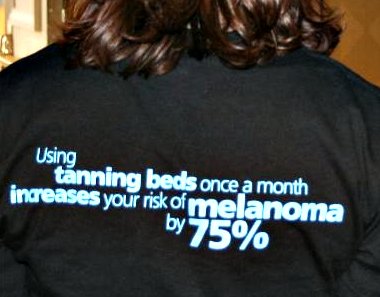
Melanoma is the second most common cancer for teens and young adults. The most rapid rate of increase in melanoma is found among females ages 15-39. People who use a tanning bed just once a month before the age of 35 increase their risk of melanoma by 75%.
Students from Concord, Franklin, Inter-Lakes, John Stark Regional, Merrimack Valley, Pittsfield, Plymouth
Regional, and Salem high schools had an opportunity
 | |
70 NH high school students attended the "Teens on Tanning Forum" in Concord on 2/18 |
to view damage to their skin using a facial scanner, learned how to talk with friends and family who tan, and worked in small groups to develop individual and community projects to increase awareness of the dangers of tanning and dispel some of the myths such as the need to get a base tan before going on a "sunny vacation." Presenters encouraged teens to "love the skin you're in." They also learned how to protect themselves from the sun by applying sunscreen properly, wearing protective clothing, and avoiding intentional tanning. Deb Girard, Executive Director of the MFNE, encouraged students to "enjoy the outdoors, be active, but do it safely."
Delivering the message about the dangers of teen tanning has become an actual academic exercise for Edie Corey, a senior at Merrimack Valley High School (MVHS) who has made the issue the focus of her senior project. "My goal is to make all 898 students at MVHS aware of the dangers of teen tanning," said Edie, who made a presentation to all freshmen and sophomore students prior to winter vacation and plans a similar program for all upperclassmen prior to prom season. "The title of my project is 'How do UV rays from the sun and tanning beds affect the skin of a healthy teenager'," added Edie, who has already been accepted into the pre-med program at the University of Maine at Orono.
Read more...
Judy Proctor
NH CCC Manager
|
| Update on NH CCC Cancer Prevention Initiatives | |
One out of three Americans will develop cancer during their lifetime. Last year, more than 500,000 people died from cancer in the United States. Here in New Hampshire, 19 of our residents are diagnosed with cancer and seven residents die due to cancer each day (see 2011 New Hampshire State Health Profile). Health experts say that one third of all cancer deaths could be prevented with lifestyle changes and by following screening recommendations. In many cases, screenings help find cancer at an early, often highly treatable stage, and in some cases can prevent cancer.
The Centers for Disease Control and Prevention recommend select screening tests because:
- Research shows that screening for cervical and colorectal cancers helps prevent these diseases by finding pre-cancerous lesions so they can be treated before they become cancerous;
- Screening for cervical, colorectal, and breast cancers also helps find these diseases at an early, often highly treatable stage .
NH CCC is currently supporting two initiatives aimed at helping prevent cancer. The New Hampshire Colorectal Cancer Screening Program (NHCRCSP) is launching "Grandparents, Let's Get Screened." This effort will help raise awareness about the importance of screening for colorectal cancer in adults aged 65 and older.
Read more...
Kris Nielson
Communications Director,
NH Department of Health and Human Services
Chair, NH CCC Communications Committee
|
|
|
NH CCC Public Policy Education Committee (PPEC) Has Been Active! | |
The PPEC has been following several bills and here is a brief summary of them as of March 2. NOTE: All bill hearings and votes are subject to change. You can check the status and text of any bill at:
http://www.gencourt.state.nh.us/bill_status/quick_search.html.
HB 1642 re: destination cancer (now named "specialty") hospitals.
NH CCC submitted a letter to the Health, Human Service and Elderly Affairs Committee indicating great concern over the bill's language that these hospitals would not take Medicaid patients and would be exempted from the state's Certificate of Need (CON) process. The issue of access to care for ALL NH residents is consistent with the NH Cancer Plan. While the bill passed the Committee with a 10-8 vote, it was much closer than expected due to the outcry from the community. It is scheduled for vote by the House on March 14.
CALL TO ACTION: Call your legislators to register your concern and ask them to vote NO on the House bill and no again if it reaches the Senate.
HB 1617 re: Certificate Of Need (CON) status.
The amended version that will strengthen the CON Board and improve the process passed committee 18-0; CON is the only opportunity for the public to weigh in on adding new facilities/services to NH. It is an important process to keep.
CALL TO ACTION: Let your legislator know that you support the CON process and the need to improve and strengthen
it.
SB 403: asks that the revenue results from the tobacco tax be reviewed at an earlier date. The legislature anticipated that the decreased tobacco tax (2011) would increase revenues, but this has not been the case to date. The hearing is available online at www.nh.gov.
CALL TO ACTION: Ask Senators to support this bill.
Read more...
Nancy Kane and Mike Rollo, Co-Chairs
NH CCC PPEC
|
|
NH CCC Workgroup Members' Research Featured in National Publication: Computer, Informatics, Nursing | |
Ellen Smith PhD, former member of NH CCC's Treatment and Survivorship Workgroup, Karen Skalla, member of the NH CCC"s Board of Directors and Treatment and Survivorship Workgroup, and others conducted a study of cancer survivors' needs in NH, Assessing Cancer Survivors' Needs Using Web-Based Technology: A Pilot Study that was published in the Feb. issue of Computers, Informatics, Nursing; Vol. 30, No. 2, 71-81.
Smith and Skalla worked with the NH CCC's Survivorship Workgroup in the development of the study. According to the summary, "The Cancer Survivor web-based survey was developed to assess the continuing needs of cancer survivors. Survey results supported that cancer survivors struggle with many enduring problems. The web-based methodology facilitated rapid accrual of a large sample, and results were quickly disseminated to those interested in using the data to suggest survivor resources."
NH CCC congratulates Smith, Skalla, and the other authors who worked on this valuable research project. |
For More Information
|
For more information about NH CCC go to our website
www.nhcancerplan.org or email info@nhcancerplan.org |
|
|



