|
Good morning!
Our newsletter is intended to be interesting and
informative covering a range of employment issues,
updating you with employment law and providing
interesting articles relevant to the construction
industry.
If you have any suggestions for future issues or
would like to see a new subject covered please let us
know. Also any nice comments on the newsletter -
or I suppose any criticisms would be welcome.
Any comments or articles in the newsletter that
concern employment law or legal matters are for
information only and you should always take
professional advice before taking any actions.
| Companies must Update Websites and Email Footers to comply with Company Law |
 |
|
Companies in the UK have since the 1 January 2007
have been required include certain regulatory
information on their websites and in their email
footers or they will breach the Companies Act and risk
a fine, warn Pinsent Masons, solicitors.
Every company should list its company registration
number, place of registration, and registered office
address on its website as a result of an update to the
legislation of 1985 to implement a European law, the
First Company Law Amendment Directive. The
information, which must be in legible characters,
should also appear on order forms and in emails.
Such information is already required on "business
letters" but the duty is being extended to websites,
order forms and electronic documents.
The information should appear in the footer of every
email sent from a company, to avoid having to decide
whether each email amounts to a "business letter" or
not. Many companies do this already because the
term "business letters" was thought likely to include
emails even without this new clarification.
For websites, contrary to the fears of some, the
specified information does not need to appear on
every page. Again, many websites will already list the
required information, perhaps on their "About us"
or "Legal info" pages.
Information that must be on your
website
The following is the minimum information that must
be on any company's website:
- The name, physical address and email address of
your company. If the company name differs from a
trading name this difference should be explained –
e.g. "AB Solutions is the trading name of ABC
Enterprises Limited."
- It is not sufficient to include a 'contact us' form
without also providing an email address and physical
address somewhere easily accessible on the site. A
PO Box is unlikely to suffice unless the registered
office address is given. If the business is a company,
the registered office address must be included.
- If a limited company, the company's registration
number should be given and, under the Companies
Act, the place of registation should be stated
(e.g. "ABC Enterprises Limited is a company
registered in England and Wales with company
number 123456")
- If the business is a member of a trade or
professional association such as REC, membership
details, should be provided.
- If the business has a VAT number, it should be
stated – even if the website is not being used for e-
commerce transactions.
- Prices on the website must be clear and
unambiguous. Also, state whether prices are inclusive
of tax and delivery costs.
For further information refer to OUT-LAW's guide, The
UK's Ecommerce Regulations:
http://www.out-law.com/page-431
|
| World's Tallest Buildings |
|
|
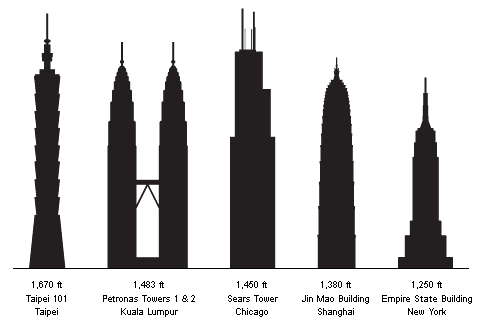
Up until 1998 the tallest building status was
essentially uncontested. Counting buildings as
structures with floors throughout, and with antennas
excluded, the Sears
Tower in Chicago was considered the tallest.
When the Petronas Twin Towers in Kuala Lumpur,
Malaysia were built, controversy arose since the spire
extended nine meters higher than the roof of the
Sears Tower. Excluding the spire, the Petronas
Towers are not taller than the Sears Tower. At their
convention in Chicago, the Council on Tall Buildings and Urban
Habitat (CTBUH) reduced the Sears Tower
from world's tallest and pronounced it not second
tallest, but third, and pronounced Petronas as world's
tallest. This action caused a considerable amount of
controversy, so CTBUH defined four categories in
which the world's tallest building can be measured:
- Height to the structural or architectural top
(including spires and pinnacles, but not antennas,
masts or flagpoles)
- Height to the highest occupied floor
- Height to the top of the roof
- Height to the top of antenna
The height is measured from the pavement level of
the main entrance. In all of these categories, Sears
Tower had held the second and third category.
Petronas held the first and the original World Trade
Towers held the fourth. Within months, however, a
new antenna was placed on the Sears Tower, giving it
hold of the fourth category. On April 20, 2004, the
Taipei 101 in Taipei, was completed. Its completion
gave it the world record for the first three categories.
Today, Taipei 101 leads in the first category with 509
m (1,671 ft); in the second category with an occupied
floor at 439 m (1,441 ft); and in the third category with
449 m (1,474 ft). The first category was formerly held
by the Petronas Twin Towers with 452 m (1,483 ft),
and before that by Sears Tower with 442 m (1,451 ft).
The second and third categories were held by the
Sears Tower, with 412 m (1,351 ft) and 442 m (1,451
ft) respectively.
The Sears Tower still leads in the fourth category with
527 m (1,729 ft), previously held by the World Trade
Center until the extension of the Chicago tower's
western broadcast antenna in 2000, over a year prior
to the Trade Center's destruction in 2001. Its antenna
included, 1 World Trade Center measured 526 m
(1,727 ft). The World Trade Center became the world's
tallest buildings to be demolished–indeed, its site
entered the record books twice on September 11,
2001, in that category, replacing the Singer Building,
which once stood a block from the WTC site.
The Ostankino Tower and the CN Tower are excluded
from these categories because they are not "habitable
buildings", which are defined as frame structures
made with floors and walls throughout.
|
| More holidays |
|
|
The DTI has announced that a worker's
minimum
annual holiday entitlement is due to increase to take
account of public holidays. For a worker working 5
days per week, the increase will be from 20 to 28
days. DTI research indicates that 6 million workers
stand to benefit from this increase.
The holiday entitlement will increase in two stages;
from 20 to 24 days on 1 October 2007, and from 24 to
28 days on 1 October 2008. There will be a second
round of public consultation on the implementation of
these changes, which will close on 13 April 2007.
For more information go to www.dti.gov.uk/employment/holidays/index.html
National minimum wage - enforcement
The DTI recently announced a new policy to fine
employers who pay their employees below the
national minimum wage and who have failed to
comply with an enforcement notice.
The DTI's policy outlines the penalty notice process
and states that the penalty calculation will be based
on twice the hourly amount of the national minimum
wage in force at the relevant time. Employers could
therefore face fines of over £200 for every worker
receiving less than the national minimum wage, in
addition to payment of arrears to the employees.
Flexible working
52% of men and 48% of women say they want to work
more flexibly, according to recent research from the
Equal Opportunities Commission (EOC).
'Working outside the box' is a report of the EOC's
investigation into transforming the workplace. The
EOC notes that 6.5 million people in Britain could be
using their skills more fully if greater flexible working
opportunities were available.
The report does indicate that employers are beginning
to change the traditional work culture. Flexitime and
home working are becoming increasingly popular and
new technology is encouraging a more innovative
approach to work. In return, employers are reportedly
benefiting from better staff engagement and raising
productivity.
Don’t forget
1 February marked the annual increase in tribunal
limits. This affects, amongst others, the maximum
compensatory award for unfair dismissal, which has
increased from £58,400 to £60,600, and the
maximum limit on a week's pay (used to calculate
redundancy payments or the basic award for unfair
dismissal), which has increased from £290 to £310.
|
| Word of the Month |
|
|
arriviste:
(noun) A person who has recently attained high
position or great power but not general acceptance or
respect; an upstart.
Synonyms: nouveau-riche, parvenu, upstart
Usage: The arriviste tried to gain acceptance into
society through ostentatious displays of his newfound
wealth, but his actions only inspired resentment
|
|
|