|
Good morning!
Our newsletter is intended to be interesting and
informative covering a range of employment issues,
updating you with employment law and providing
interesting articles relevant to the construction
industry.
If you have any suggestions for future issues or
would like to see a new subject covered please let us
know. Also any nice comments on the newsletter -
or I suppose any criticisms would be welcome.
Any comments or articles in the newsletter that
concern employment law or legal matters are for
information only and you should always take
professional advice.
| Check hazardous waste rules or face prosecution |
 |
|
Firms are being urged to check whether they are
required to register with the Environment Agency
under the new Hazardous Waste Regulations - or risk
prosecution or an on-the-spot fine.
Under the rules, which came into force 16 July, some
everyday business waste will be classed as hazardous
for the first time. Items include computer monitors
and fluorescent-lighting tubes.
Many firms producing this type of waste are now
required to register, with non-compliant firms
facing prosecution or a £300 on-the-spot fine. The
maximum penalty a court can impose is £5,000.
Those that fail to register are also likely to
encounter difficulties disposing of their waste,
because it is now an offence for a third-party waste
disposal company to handle waste from an
unregistered firm.
"It is essential that businesses act now," said Ben
Bradshaw, Minister for Local Environmental Quality.
"With many firms finding themselves hazardous waste
producers for the first time, the full implications
of the controls are yet to be fully realised."
Businesses in some sectors and which generate less
than 200kg of hazardous waste a year are exempt
from
registration. These include offices, shops, premises
used for agriculture, and dental, veterinary and
medical practices.
According to the Environment Agency, 200kg of waste
equates approximately to one of the following:
* 10 small televisions;
* 14 lead acid batteries;
* 500 fluorescent tubes;
* five small domestic fridges.
|
| Life is not a static thing |
|
|
"Life is not a static thing. The only people who do
not change their minds are incompetents in asylums,
who can't, and those in cemeteries."
- Everett M. Dirksen
|
| Campaign launched to tackle age discrimination |
|
|
Organisations representing businesses, employers,
trade unions and government departments have
launched a campaign to encourage firms to get
to grips with the benefits of an age diverse workforce.
The Age Partnership Group (APG) is offering best
practice advice to firms on avoiding age
discrimination, ahead of new legislation due to be
introduced in October 2006. The draft regulations
are set to be released this summer.
The legislation will outlaw age discrimination in
employment and vocational training. It will cover
public and private sectors, and include young and
old alike.
The APG believes employers can benefit from ensuring
they adopt non-ageist employment practices. "With
the current skills shortages and the changing
demographic position, older workers are forming a
larger proportion of the workforce," said an APG
spokesman.
"Many employers have already found that employing
an
age diverse workforce brings business benefits and
savings through fostering a skilled and
well-experienced workforce."
According to the APG, there are around 19 million
people aged 50 and over in the UK - 40 per cent of
the adult population. Currently just over six
million people aged between 50 and state pension age
are in employment, an employment rate of 69 per
cent.
As part of the APG campaign, firms can order a
free CD Rom or personnel organiser containing advice
to help avoid age discrimination.
To order a free CD ROM or personnel organiser
contact 0845 715 2000
|
| Breaking the law with inadequate motor cover |
|
|
One in 10 fleet drivers who have opted for a cash
alternative instead of a company car do not have
adequate insurance for the vehicle when used on
business, according to a major survey of hundreds of
drivers.
Under the law, people who drive private vehicles for
work should check that their policy covers them for
business use. But according to Motorinsurance.co.uk,
people admit to either "not having" or "not knowing
whether they have" appropriate cover.
This was despite 82 per cent of respondents claiming
they drove a private vehicle at least 50 miles on
business each week. A further quarter said they
drove more than 500 miles a week for work.
"Policies that cover you for 'social domestic and
pleasure' purposes may also cover you in respect of
travelling to and from your place of work, but will
not cover your actual business use once at work -
unless you have specific business use on your
policy," a spokesman for the Association of British
Insurers said.
The best thing to do, he advised, is to check with
your insurer what your cover includes. You should
check with employees who use private vehicles for
work to ensure their cover is valid. 'If a vehicle
is not covered by the correct insurance and it is
stolen or damaged when being used for business, the
insurer could void the claim so it is very serious.'
Motorinsurance.co.uk Managing Director, Andrew
Dunkerly, said he believed more and more people were
at risk of breaking the law, as businesses
increasingly found it too expensive to provide
company car schemes and the associated insurance.
However, he warned that this is not a valid excuse.
"In simple terms, if they are not properly insured,
they are breaking the law. It really is a serious
matter."
|
| Windows - and nothing to do with Mr Gates! |
|
|
Most houses of the Victorian and Edwardian periods
had sash windows throughout; only in the Arts and
Crafts and Edwardian mock Tudor styles was the
casement style typical.
The development of the sash window followed these
stages:
- The earliest sashes had no pulley sets; the was
set at the outside of the wall.
- The next stage saw the introduction of boxes
- The 1709 London Building Act specified that the
windows should be recessed into the wall to reduce
the risk of fire. This rule did not apply elsewhere.
- The 1774 London Building Act specified that the
windows should be rebated fully.
- In 1820 it was made a national requirement that
windows be fully rebated.
The 1820's house from Belfast, shown in the picture
above, still has it's sash windows unrebated. The
window is uncorded and so has to be wedged when
open. The head and sill were of wood. The head
rotted rapidly and the bricks above tended to
collapse.
Larger sashes, going from near the ceiling down to
floor level, were suspended on chains rather than
ropes.
Inside, the windows were painted dark brown or white
to match the room décor.
In the Georgian era, on the outside, windows were
dark brown in plain paint or grained. Victorian and
Edwardian windows were generally painted the same
as
other exterior woodwork; typically a dark colour,
perhaps with white-painted detail.
Plate glass came into widespread use in the
mid-1800s once the special taxes on this type of
glass were abolished; windows and the panes
themselves became larger.
As windows were made from fewer but larger panes,
sash horns were introduced to give greater strength.
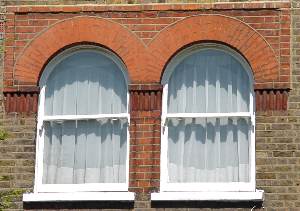 early Victorian round topped
sash early Victorian round topped
sash
Public and street-facing rooms typically had
Venetian blinds (wooden slats) or roller blinds,
with nets and conventional curtains. Sometimes a
fringed and braided silk or taffeta casement blind
was used. Swagged curtains were not common. Chintz
fabric was popular. Brass poles were used.
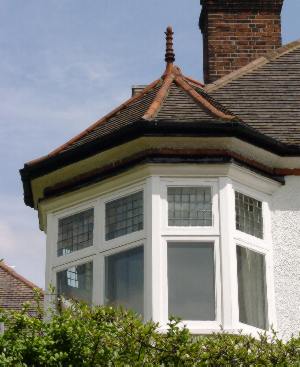 Edwardian bay with casements
and fanlights over Edwardian bay with casements
and fanlights over
Researchers at Imperial College London have
rediscovered in 2003 that sash windows are very
effective at increasing the airflow in a building;
they should be open equally at the top and bottom
and in hot weather opened fully at night to cool the
building for the following day. Blinds allow this
airflow while giving shade and privacy.
|
|
Ideas and Comments |
|
|
|
If you have any ideas or comments of what we can
include in the newsletter please keep them to
yourselves - no please use the link below and email
Bob and as long as it's legal he will atempt to use
your ideas.
|
|


