Not On Our Mailing List?
|
 |
Developmental Activity
of the Month
Autumn Leaves Placemats and Coasters
|
This is a simple autumn activity that you can complete with any age child after taking a walk among the fallen leaves.
What you'll need:
A variety of colored leaves from different kinds of trees. Clear contact paper.
How to make it:
Cut 2 pieces of contact paper into large rectangles, squares or circles, whatever shape placemat your child desires. Peel the backing off of one piece of contact paper and let your child arrange the leaves in any pattern they prefer by sticking them to the contact paper. Help them position the second piece of contact paper on top, smooth out the wrinkles and you now have an easy autumn placemat. You can also space the leaves farther apart and once sealed, cut around the leaves to make coasters.
Tips:
This is a simple activity to complete after a hike or a simple walk around the neighborhood. Have your child take a bag and gather up 10-12 leaves from various trees in various colors. You can discuss colors with young children, and with older children you can help them learn to identify different types of trees and even make it into a science lesson by discussing why leaves turn colors by visiting this link:
Why Do Leaves Change Colors?
|
|
|
OUR SPONSORS
|

|
|
|

|
Dear Parenting Digest Subscriber,
The first frost has just spread itself across the grass and the leaves are falling from the trees. Halloween is just around the corner, which can only mean that all those other busy holidays will be here before we know it.
Our October issue of Parenting Digest gives you some practical suggestions for helping your children cope with hair cuts, bath time, nail trimming and some of those other daily routines which may not be so pleasant for them. We also discuss the pros and cons of using a pacifier. Don't forget to try our simple autumn leaf placemat and coaster craft which is suitable for kids of any age.
If you haven't checked it out already, be sure to visit our newly redesigned Early Intervention Support website, which helps you more easily browse our web page and locate important developmental information.
Early Intervention Support is a place for families who are facing any challenge
pertaining to their child's growth and development. It is a place where you can
come to find answers and practical suggestions from licensed therapists on how
to work on a variety of issues. Whether you are a parent, grandparent or
therapist of a child with a disability, challenging behavior or other
developmental issue-childhood is short, it should be savored and enjoyed!
|
|
FEATURED ARTICLE: Hygiene Horrors!
|
By Nicole Sciulli, MOTR/L
Do you dread giving your child a bath, trimming her nails, wiping her face or nose, or taking your child to get a haircut?
Don't worry, you
are not alone. There are many parents out there who can sympathize
with your frustrations. This article will give you some suggestions
to try at home with your child to help make these hygiene routines a
little more tolerable.
To
begin, your child may be acting this way because his sensory system
is more sensitive to touch than other children's. In order to help
your child, there are several desensitizing activities and techniques
that you can use to make his sensory system less sensitive. It will
take some time to reduce these sensitivities, but if you hang in
there and are consistent with trying these suggestions you may see an
improvement.
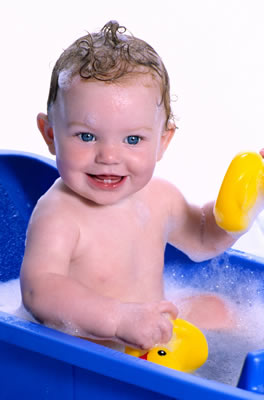
Bath
time is supposed to be a fun and relaxing time of the day. The child
can play with toys, splash around, and even pretend to swim like a
fish! But with some children bath time is a sensory overload. You
are using a soft washcloth to wash your child, you are touching him
all over his body and you are scrubbing his head. Depending on how
much water is in the tub, they may feel unbalanced or insecure while
sitting.
Here are some suggestions to help make bath time easier:
- When washing your
child with a washcloth, try using a firm pressure instead of a light
touch to wash. The light touch of the washcloth may actually be
tickling your child.
- Try singing a song;
such as "Head, Shoulders, Knees, and Toes" while washing so the
child is aware of which area of the body you will be washing next.
- Use a firm pressure
on the head when washing the child's hair. Deep pressure is more
calming than light touch.
- You can even try finding a mirror that
suctions to the bathtub so that your child can see himself and allow
him to help you wash his hair.
- Try putting less
water in the tub so the child feels more secure while sitting.
|
The Pros and Cons of Pacifier Use
|

By Tamara Guo, M. Ed.
Many parent's ask themselves "Should
I let my baby use a pacifier?" or "If my baby uses a pacifier,
will it harm his teeth or become a hard habit to break?". Basically
if you ask your pediatrician or your child's therapist they will
probably tell you that there are both pros and cons to using a
pacifier and that the ultimate decision is yours.
The Pros:
- Often helps to soothe a crying or fussy
baby
- Can help some babies to fall asleep
more easily
- Can be offered as a temporary
distraction when waiting to feed a baby
- Can help prevent SIDS some research has
shown
The Cons:
- Prolonged pacifier use can lead to
dental problems
- Can interfere with breast feeding
- Babies can become dependent on
pacifiers to go to sleep and never learn to self soothe
- Can be a hard habit to break
- Can increase the risk of ear infections
Tips for Pacifier Use
If you choose to use a pacifier the
American Academy of Pediatrics recommends waiting until your baby is
at least one month old so that your breast feeding routine is solidly
established. Try other methods of soothing your baby before resorting
to the pacifier. Keep the pacifier clean by cleaning it with soap &
water and letting it air dry. Make sure pacifiers are free of cracks
and never hang a pacifier around a baby's neck using a string. Most
children stop using a pacifier on their own between the ages of two and four, and most dentists agree that pacifier use doesn't harm dentition
unless used well past the age of five when permanent teeth are due to
come in. Consider weaning your child from the pacifier before age
one, as it becomes more difficult after this time (but consider that
thumb sucking is even harder to discontinue than pacifier use).
Sucking is a natural instinct and
reflex for babies, but as children get older they begin to outgrow
the need to suck on a pacifier, their fingers or toys. Children who
do not outgrow this stage by the end of toddlerhood may have what we
call an "oral fixation".
Stay tuned to our November 2009 issue of
Parenting Digest where we will discuss the topic of Oral Fixation.
|
|
|
"Delicious autumn! My very soul
is wedded to it,
and if I were a bird I would fly about the earth
seeking the successive autumns."
~George Eliot ~
From The Team At Early Intervention Support
|
|
|



