Subscribe
 |
|
|
Dear CIPS Members:
 | |
Caron Harrang, LICSW, FIPA
|
In this last issue of the academic season, we review the CIPS Clinical Conference held at the Ritz Carlton in Marina del Rey on May 4-6, 2012. This year's theme addressed the topic of Sexuality in the Second Century of Psychoanalysis. For those who attended, we hope you enjoy reading reflections from Leigh Tobias, James Grotstein, and Lisa Halotek. If you were not able to attend this year's conference we hope what's shared here will whet your appetite for the next Clinical Conference planned for 2014. We are also very proud to announce the publication of the next book in the CIPS Book Series: Absolute Truth and Unbearable Psychic Pain: Psychoanalytic Perspectives on Concrete Experience, edited by Allan Frosch. Contributors include Maxine Anderson, Alan Bass, Joseph A Cancelmo, Paula Ellman, Allan Frosch, Nancy R Goodman, Laurence J Gould, myself, Richard Lasky, and Janice Lieberman. The book will be available for purchase on our website within a week or two after receiving this newsletter (www.cipsusa.org).
Also in this issue, we have an update from NASsaC, a complete listing of teleconference study groups, an interesting article by Lisa Kowalczyk who writes for the Boston Globe on medical records privacy sent to us by Rick Perlman (Chair, Public Policy Committee), and, as always, brief reports from several of our member societies.
Have an enjoyable summer and watch for the September/October issue of the News Brief later this fall. In the meantime, please continue sending news from your local society via any CIPS director. See the list of email addresses below for how to contact each of us.
|
|
CIPS Board of Directors
| |
Officers:
- President: Leigh Tobias (PCC)
- Secretary: Randi Wirth (IPTAR)
- Treasurer: Sandra Borden (IPTAR)
- Recording Secretary: Marilyn Rifkin (IPTAR)
Directors:
Directors represent the interests of their local society and institute on the CIPS Board of Directors and act as reporters to collect submissions from members for the News Brief. News may pertain to future events, in which case announcements should be submitted two months in advance. Or submissions may be in the nature of a report on a recent conference, scientific meeting, or other psychoanalytic professional event. Please contact your local society director with questions or submissions.
|
|
|
Sexuality in the Second Century of Psychoanalysis
The 2012 CIPS Clinical Conference was held at the Ritz-Carlton in Marina del Rey, California, May 4-6, 2012. This year's theme was Sexuality in the Second Century of Psychoanalysis, exploring the differences between pre-genital and Oedipal development on character formation. In that the conference focuses entirely on discussion of participants' clinical material in small heterogeneous work groups made up of candidates, analysts, and training analysts, it is impossible to convey the range of individual experience. Nevertheless, we hope that the following conference summaries from CIPS President Leigh Tobias and LAISPS senior candidate Lisa Holotek give you a sense of the richness and uniqueness of the conference experience.
******
Leigh writes, "The CIPS Clinical Conference (May 4-6, 2012) was, again, well attended and valuable to most participants. Presenting and discussing clinical material with colleagues from different societies consistently brings a fresh view to the material and enlivens the clinicians immeasurably. I am also happy to report that our colleagues in Mexico would like us to export our conference to their region as well!
"The evening social event, this time a cocktail party by the bay, gave the CIPS Board an opportunity to again acknowledge and honor several longtime members who have made significant contributions to our profession and to CIPS. We gave an encore, on their home turf, to James Gooch, Albert Mason, Fredrick Vaquer, and Peter Wolson. All are founding members from the West Coast who had been honored at the previous CIPS conference in Manhattan three years ago. We then honored Hedda Bolgar and James Grotstein for their indefatigable and ongoing contributions to CIPS and to the field of psychoanalysis.
"Hedda Bolgar has a lively professional and personal history that you can learn in interesting detail in the 4th CIPS volume, The Second Century of Psychoanalysis, as well as in the recent video about her produced by LAISPS. She came to the United States from Vienna where she was one of the earliest psychoanalytic graduates from the University of Chicago. She was a colleague of Franz Alexander in Chicago before moving to her current home in Los Angeles. Always one to address an unmet need regarding the mental health community, Hedda developed psychological health programs at Cedars Sinai. She went on to be a founding member of the Wright Institute, offering outstanding training for pre- and post-doctoral psychology students in psychoanalytic and psychodynamic treatment, and developed an adult community clinic there, which bears her name. She then became a founding member of LAISPS, where she is a training and supervising psychoanalyst. She has been an influential mentor to countless analysts in Los Angeles, in the United States, and internationally. Hedda has been a tireless champion of underserved populations, recognizing and supporting the treatment needs of those immigrating from oppressive political regimes, at risk children, and veterans via the Soldiers Project and the Ernest Lawrence Trauma Center. A current clinical interest of Hedda's is trauma resulting from forced political migration. A founding member of CIPS, Hedda helped to form the organizational identity of the Independent Institutes in North America, and promoted cooperation by helping to organize previous CIPS Clinical Conferences. She loves cats, is exquisitely fashionable, and to this day generously shares her home and mind with those of us fortunate enough to live in the Los Angeles area. She is still supervising, writing, presenting papers, and inspiring new generations of psychoanalysts. She was honored this year in Washington, DC as one of two most senior members of the United States workforce. At 102 she is still going strong!
"James S Grotstein is also a beloved teacher and leader for our community. He is well known for speaking and translating several psychoanalytic "languages"; that is, for keeping a constructive and productive discussion going among many analytic schools of thought. He is a Clinical Professor of Psychiatry at the Geffen School of Medicine (UCLA) and a training and supervising analyst at the New Center for Psychoanalysis and the Psychoanalytic Center of California. Jim is also a member of the editorial board of the International Journal of Psychoanalysis and a Past North American Vice President of the IPA. He has written 12 books and 287 articles on a variety of psychoanalytic topics. These accomplishments, however, pale next to his warmth, good humor, insight and vibrant mind, which enable him to bring theory "close" to his students and colleagues. Jim is open to new ideas and has developed a few of his own. Two recent examples being his thinking expressed in, Who is the Dreamer who Dreams the Dream?, and, A Beam of Intense Darkness: Wilfred Bions's Legacy to Psychoanalysis. He has left a legacy of supervision and technical understanding, including key phrases that have become familiar idioms among those who know him and have read his work; one has become the title of his latest two volumes: At the Same Time and on Another Level. Jim has been industrious enough, kind enough, and creative enough to provide the psychoanalytic community with enough written material to digest for many lifetimes.
"Both honorees gave a gracious thank you to the CIPS community and commended all of us for our efforts. Jim sent me these thoughts the following day, which I will share with you:
It was all so wonderful. I am so grateful to the CIPS Board, and to your whole organization, for the honor you bestowed on me and also the way you did it, so graciously. I was very moved.
I don't know if I made my point clear, but what I meant to say is that I had a vision of the important resource CIPS has at its disposal and the numbers of (our profession) that suffer from homogeneity. They all speak the same mantra with the same accent. CIPS has the advantage of being heterogeneous within a homogenous group; therefore you can explore different psychoanalytic points of view with each other.
But I also envisioned a larger view, one that reaches out to our culture politically and otherwise. It dawned on me that the newfound power of the religious right, of the evangelical movement, is due in no small measure to many charismatic ministers seizing the advantage of the media and converting masses of people because of the reach of television. Could this not be a means for psychoanalysis to propel its mission, along many lines, including infant development, education about the range of psychotherapies available, lectures on projection and rhetoric, etc? Or am I a dreamer? I think maybe I am, but it did occur to me, and I did want to share [this thought]. I think we do owe our accumulated wisdom and collective experiences for the common good of the public. If the "bad guys" can do it, why can't the "good guys"?
Thank you more than I could ever say.
Warmly,
Jim
"We are deeply grateful for our founding members and our honorees for contributing so much to us, and are left with their calls to action: we can be a political force as well as an educational one; we can meet need where we find it, we have strength in our collective effort, and we can export our clinical conference. CIPS has plenty to do! Thank you to the Board for your continued efforts on behalf of CIPS members and affiliates, and to all who attended for the commitment to our ongoing development as analysts."
Leigh Tobias, PhD, FIPA is the current President of CIPS and an active member of PCC.
******
Lisa read the following summary at the closing large group discussion on the last day of the conference. She began saying, "This year's CIPS conference lived up to its reputation as a stimulating clinical event where analysts exchange ideas in a small group setting. As the conference got underway, one particular question came up: What is a productive group, and what effect does its leadership have on the group's development?
"My particular group was comprised of four men and three women, CIPS members from Seattle, Mexico, and Los Angeles. Our levels of experience ranged from that of candidate to founder of an institute, and encompassed various theoretical orientations, as well-in other words, a diverse mix. Our group facilitator, John Lundgren, courageously led by example. When he asked who in our group would volunteer to first present clinical material, and was met with silence, he himself volunteered to start things off, and allowed for his own vulnerability to show through in the presentation of his case. One by one, we presented our work, and listened to each other from the perspective of what was taking place inside of our minds as we listened to each analytic couple and attempted to understand them. We discussed the varying levels our patients were at in their development, as well as the fact that symbol formation, an awareness of separateness, and the ability to tolerate anger and love were all precursors for the development of healthy sexuality.
"Most of the cases presented were at this pre-Oedipal level. We thought about each analytic couple's emotional intercourse, and the different states of mind we encounter in our work; from the uptight and rigid, to the fluid, wherein the couple doesn't feel they have to tear each other up. We were reminded of how hard this work can be and the importance of creating ongoing opportunities to share our work with colleagues.
"The differences between intrapsychic conflict and deficit issues were seamlessly amalgamated in the clinical discussion. Both perspectives were acknowledged and appreciated without dissension.
In the end, we realized that although we may each have different theoretical backgrounds, by leaving our theories at the door, and simply presenting our material, our responses to each other were not polarized. Moreover, a collegial bond was created that the discussion of theory couldn't interrupt. Not that we didn't get to some theory-we did. But, we worked our way to it from the bottom up, starting with our experience and what was stimulated in each of us as human beings.
Lisa Halotek, LCSW is a senior candidate (LAISPS) and was the participant/recorder for the conference group comprised of Caron Harrang (NPS), Emelia Kanan (Mexico City/DMS), John Lundgren (PCC/facilitator), Norman Oberman (LAISPS), Jon Tabakin (PCC), and Peter Wolson (LAISPS).
|
| CIPS Book Series on the Boundaries of Psychoanalysis |
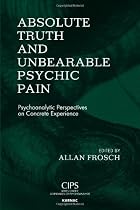 ABSOLUTE TRUTH AND UNBEARABLE PSYCHIC PAIN ABSOLUTE TRUTH AND UNBEARABLE PSYCHIC PAIN
Psychoanalytic Perspectives
on Concrete Experience
Pbk 176pp,
June 2012
ISBN: 9781855757981
EDITED BY ALLAN FROSCH
'This timely, thoughtful book delves into the burgeoning psychoanalytic topic of "thinking about thinking". The editor has chosen wisely in inviting a wide range of perspectives that demonstrate the excitement and complexity of integrating this essential and important task into our understanding of the therapeutic process. Reading it will be of invaluable help for the clinician who works with a broad spectrum of patients and is interested in expanding and refining treatment methods and techniques. Sophisticated and enjoyable to read, this book brings its readers to the forefront of our contemporary discourse and is a most stimulating contribution to "thinking about thinking".'
Fred Busch, PhD, Training and Supervising Analyst at the Psychoanalytic Institute of New England, and Fellow of the International Psychoanalytical Association (FIPA)
'For people who are willing to work with patients who experience their feelings on a concrete (or desymbolised) level and who can be very inaccessible to an analyst's attempts to reach them, this book is a very positive and encouraging statement about what work can be done. With incredibly sensitive and open discourse, each chapter reveals how, using many different aspects of one's self and not being put off by the long time it takes to reach such patients, one can eventually get to the underlying unbearable psychic pain that leads to concrete thinking. Rather than believing that these patients aren't capable of "analytic work", these analysts help their patients over time to transform concrete thinking to higher level abstract and symbolic thought and show how trauma can be eventually worked through. Congratulations to Allan Frosch and his group of excellent contributors for such an encouraging and important book.'
Carolyn Ellman, PhD, Training and Supervising Analyst at the Institute for Psychoanalytic Training and Research (IPTAR) and the New York Freudian Society
About the Editor: Allan Frosch, PhD, FIPA, is a training analyst and supervisor at the Institute for Psychoanalytic Research and Training (IPTAR) where he is also on the faculty. He is the author of a number of psychoanalytic articles and is twice past president of IPTAR, former dean of training, and former co-director of the IPTAR Clinical Center. Dr Frosch is also on the faculty at the Institute for Psychoanalytic Education (NYU Medical Center).
Contributors: Maxine Anderson, Alan Bass, Joseph A Cancelmo, Paula Ellman, Allan Frosch, Nancy R Goodman, Laurence J Gould, Caron E Harrang, Richard Lasky, and Janice Lieberman
|
|
CIPS Authors Publication News
|
 Bion and Being: Passion and the Creative Mind by Annie Reiner Bion and Being: Passion and the Creative Mind by Annie Reiner
With his concept of "O," Wilfred Bion provided a new psychoanalytic space in which to explore the mind. Annie Reiner's new book, Bion and Being: Passion and the Creative Mind, examines the similarities between this psychoanalytic space and the artist's creative sensibility, as well as mystical and religious states. This most mysterious and revolutionary of Bion's analytic ideas reflects what is essentially a state of being, an experience of mental integrity and union between emotional and rational functions of the mind which is the basis of thinking and creativity. In an effort to provide emotional understanding to Bion's theoretical ideas, Reiner uses examples of artists, poets, writers, theologians, and philosophers, including Rilke, Cummings, Shakespeare, Beckett, and Nietzsche, to illustrate these psychoanalytic concepts. She also presents detailed clinical examples of patient's dreams to explore the obstacles to these states of being, as well as how to work clinically to develop access to these creative states.
Click here to read reviews by James Grotstein, Warren Poland, and James Gooch or to order the book >
Annie Reiner, FIPA is a member and senior faculty member of The Psychoanalytic Center of California (PCC) in Los Angeles, and a fellow of the International Psychoanalytical Association (IPA). Her work was profoundly influenced by the ideas of Wilfred Bion, with whom she studied in the 1970s. Her psychoanalytic writings have been published in various journals and anthologies. In addition to her work and writings as a psychoanalyst, Annie Reiner is an accomplished playwright, poet and painter. She is the author of four books of poems, a book of short stories, and four children's books that she also illustrated. She maintains a private practice in Beverly Hills, California.
|
|
CIPS Teleconference Study Groups
|
Here is a complete listing of new and ongoing study groups and facilitator(s):
- A Fruitful Harvest: Essays After Bion - Jeffrey Eaton, LMHC, FIPA (NPS) - NEW
- Creating A Psychoanalytic Mind - Fred Busch, PhD, FIPA (IPTAR & PINE) - NEW
***
- Bion 1 - Maxine Anderson, MD, FIPA (NPS) and Marianne Robinson, PhD, FIPA (NPS) - Full (no openings at this time)
- Bion 2 - James Gooch, MD, FIPA (PCC) - Limited openings
- Enactment - Nancy Goodman, PhD, FIPA (DMS & CFS) - Full (no openings at this time)
|
|
NAPsaC Update
|
NAPsaC Officers: Robert Pyles (Chair); Fredric Perlman (Secretary); David Falk (Treasurer)
Board of Directors: Liz Fritsch (CFS), Martin Gauthier (CPS), Caron Harrang (NPS), Peggy Porter (LAISPS), Maureen Murphy (PINC), Phyllis Sloate (IPTAR), Leigh Tobias (PCC)
Alternate Directors: Dana Blue (NPS), Andrew Brook (CPS), Louis Brunet (CPS), Margaret Ann Hanley (CPS), Beth Kalish (LAISPS), Marilyn Rifkin (IPTAR), Charles Spezzano (PINC), Randi Wirth (IPTAR)
The North American Psychoanalytic Confederation, or NAPsaC, is a confederation of IPA component groups, formed in 2003 to enable the North American societies of the IPA to communicate with each other, to collaborate with each other on projects of mutual interest, and to facilitate decision-making by the component groups of North America in response to the administrative and governance requirements of the IPA.
At its January 2011 meeting, the NAPsaC Board voted unanimously to incorporate, develop bylaws for NAPsaC governance, and seek tax-exempt status. NAPsaC secured incorporation late in 2011, and adopted formal bylaws at its January 2012 meeting. NAPsaC is now working to attain non-profit status.
On June 3, 2012 the Board held a tele-conference meeting to review developments since the January meeting. Warren Procci (APsaA) chaired the meeting. The main item of business was a motion to amend the bylaws to include provisions that will increase the likelihood that the Internal Revenue Service will grant us tax-exempt service. The board voted to include the entire text recommended by the IRS. In addition, Warren Procci announced his appointment of David Falk to the position of NAPsaC Treasurer. The meeting included discussions of possible organizational goals for NAPsaC. Following the meeting, Warren Procci was succeeded as NAPsaC chair by Robert Pyles, the new APsaA president.
The NAPsaC board will meet again in September to further discuss organization goals. CIPS members are encouraged to develop their own ideas about what projects or initiatives they would like NAPsaC to take up. What can NAPsaC do that our individual societies cannot do alone? The NAPsaC Board invites you to share your thoughts and "wish lists" with your local society representatives.
|
|
Public Policy News
|
The following story was sent to us by Rick Perlman who chairs the CIPS Public Policy Committee. Click here to watch a short video bio about health care reporter, Liz Kowalczyk, who wrote the following article >
"As records go online, clash over mental care privacy"
By Liz Kowalczyk
Globe Staff
June 21, 2012
At her weekly therapy sessions, Julie revealed her most uncomfortable secrets: depression, debt, and childhood sexual abuse. Her psychiatrist at Massachusetts General Hospital would then type a summary into Julie's computerized medical record. With that, more than 200 pages of sensitive notes became available to any doctor who cared for her within the sprawling Partners HealthCare system. She discovered this only when one doctor later referenced the notes. Julie, a 43-year-old lawyer, was unnerved, then angry. "The details are really nobody's business," she said. But Partners disagrees. Doctors must have a complete picture to make accurate diagnoses, the organization argues. And having different rules for psychiatric records contributes to the stigma of mental illness.
The clash reflects the delicate privacy issues surfacing as electronic medical records become widespread. Providers in separate networks are preparing to share patients' records more widely online - to better coordinate care and cut wasteful spending. This will probably intensify the debate about what should and should not be shared, as well as fears about the unauthorized release of patient information.
Both the House and Senate health care cost-control bills passed this spring require the state to create a system for sharing records across provider networks. This is also a priority for Governor Deval Patrick, whose administration already is working on the project, which includes stringent patient privacy protections. Dr. David Blumenthal, Partners's chief health information and innovation officer and former national coordinator for health information technology for the Obama administration, said the privacy issues "are huge.'' Though technology has advanced to allow providers to share records, patient trust remains an obstacle to adoption of these systems, he said. "It's one thing to give your psychiatrist the right to share your information [with certain doctors], it's another to enter your data into a system that makes it available with relative ease to an unknown number of physicians who may be involved in your care. Most Americans see the benefits as much greater than the risks. But there are groups who are very uncomfortable with their records being shared with people they have not specifically designated.''
Doctors and hospitals in Massachusetts have been quicker than those in many other states to adopt computerized patient records, with between 35 and 45 percent using at least a basic system, according to a recent study. Under federal health privacy laws, patients must sign a standard permission form for providers to share their medical information for purposes of treatment and billing. Policies on sharing psychiatric notes vary. At Beth Israel Deaconess Medical Center, for example, psychiatrists decide whether to put notes in a locked area of the record, which other doctors can see only if they provide written justification.
At Partners, patients can ask that notes be restricted, but the organization evaluates the requests on a case-by-case basis. In the case of Julie - who does not want her full name published because she's worried about being stigmatized - Partners eventually agreed to restrict access to the therapy notes written between 2002 and 2009. But the provider network would not automatically sequester future notes.
Julie believed she should control who sees her psychiatrist's notes. "These are issues I haven't talked about to anyone . . . not even my closest friends," she said. As a result, she found a therapist outside the Partners system, who will not put notes in an electronic record.
Dr. Judy Ann Bigby, Patrick's secretary of Health and Human Services, is overseeing what will be the first statewide "health information exchange,'' which will enable providers in different networks to share patient records online - but only with patients' permission, she said. Patients will decide which records they are willing to share among providers, and the consent forms will be kept in a central database. For example, a patient may decide to share medical records from Mass. General but not those from McLean, a psychiatric hospital, said Dr. John Halamka, chief information officer at Beth Israel Deaconess Medical Center and an adviser to state officials. If the patient ends up in the emergency room at Beth Israel Deaconess, for example, doctors there would not be able to read the McLean records. Halamka said the state is still working out whether patients will be able to share portions of their records from a particular hospital, while still restricting sensitive information, which is more technically complicated.
The House health care cost-control plan requires all providers to have "interoperable'' medical records by 2017. Representative Steven Walsh, a Lynn Democrat who led the House effort, said state officials will develop privacy rules later, including when a patient's consent is required for information to be shared. He said he believes treating doctors in different networks should have access to a patient's diagnosis, medications, and other key information, but not necessarily to psychiatric notes.
Dr. Scott Monteith, a Michigan psychiatrist who was on a panel with Julie at a privacy conference in Washington, D.C., earlier this month, said widely sharing detailed mental health information could make patients clam up. "There is a huge stigma and patients know it. They don't tell their story,'' he said. But Dr. Thomas Lee, head of Partners's physician network, said segregating psychiatrists' notes fosters that stigma. "Schizophrenia and Parkinson's disease are both biochemical disorders of the brain. Why is one considered mental health and the other medical?''
Primary care doctors can learn important information about their patients from psychiatrists' notes, such as whether a person is at risk for suicide, Lee said. "Psychiatrists really talk to patients and they really listen,'' he said. Regardless, Julie said the decision is for her and other patients to make, not providers. When she began seeing her psychiatrist in 2002, the therapist never mentioned the possibility of separating therapy notes from the rest of her computerized record, Julie said. Seven years later, Julie decided to switch therapists and requested her records. She saw then that they included the 200 pages of notes. But she didn't realize other doctors had access to these notes until she went to see a new internist for a stomach ache. She wanted him to manage her medications for bipolar disorder while she found a new therapist. He gave her a cursory exam and encouraged her to see a psychiatrist, she said in an interview. The doctor told her he had read the notes and was not comfortable prescribing her medications, although he eventually agreed to do so. "A lot of doctors don't really feel comfortable with people who have a mental illness,'' she said. "They don't have enough training and even good doctors will make a judgment and won't try to rule out other things. They make the assumption that it's psychosomatic.''
|
| CIPS Societies News | |
Direct Members Society (DMS)
Institute for Psychoanalytic Training & Research (IPTAR)
- The institute is pleased to announce the graduation on June 3, 2012 of Toba Tokgoz from the Adult Psychoanalytic Training Program, and of Rob M Fierstein, LCSW from the Child & Adolescent Psychotherapy Training Program.
Los Angeles Institute & Society for Psychoanalytic Study (LAISPS)
Northwestern Psychoanalytic Society (NPS)
- NPS is moving, as of July 2012, from its longtime home in the Capitol Hill neighborhood to a new location in downtown Seattle. Headquarters for the Society and Institute will be at the First and Cedar Building (2701 First Avenue #120; Seattle, WA 98121). A celebration open to the local mental health community is planned for Wednesday, July 11 (7:30-9 pm) immediately following the NPS Annual Membership Meeting (7-7:30 pm). On this occasion, an election of officers will also take place. Judy K Eekhoff, PhD, FIPA will complete her term as Past President. David Jachim, PhD, FIPA is being nominated for the Presidency and Caron Harrang, LICSW, FIPA is being nominated for the position of President Elect. Acting Director of Training Maxine Anderson, MD, FIPA will be nominated for the position she was appointed to by the NPS Board earlier this spring.
 - NPS is continuing to prepare for its annual international Evolving British Object Relations conference rescheduled to September 7-9, 2012. The theme this year is Emotion and Meaning in Object Relationships: Experiences of Oedipal Constellations. How do mother and father's conscious and unconscious emotional union create meaning for the baby? How does unconscious emotion impact the discovery of meaning? Where does meaning originate? Do Oedipal configurations inform us when we are with our patients? This conference will explore these questions of internal relationships in light of our clinical experience. Featured presenters are Richard Rusbridger, FIPA (London), Gisela Klinckwort, FIPA (Munich), Michael Ian Paul, FIPA (Los Angeles), and moderator Robert Oelsner, MD, FIPA (Seattle). The call for papers deadline is July 1, 2012. Click here for conference details and registration. For information not covered on the website, please contact conference committee chair, Judy K Eekhoff at jkeekhoff@comcast.net.
Psychoanalytic Center of California (PCC)
- The Psychoanalytic Psychotherapy Program Committee honored 7 students who completed this year's Psychoanalytic Psychotherapy Certificate Program, 5 of whom finished an optional second year of the program, at the annual PPP Graduation on Sunday, June 10, 2012.
- Desy Safáan-Gerard Exhibition in Paris. On opening night, June 16, 2012, Safán-Gerard painted with both hands while a model moved slowly to the music of Pierre Boulez's Notations I-IV for orchestra. Her exhibition is on display through July 1, 2012 at Galerie Dufay/Bonnet; Cité artisanale 63, rue Daguerre; 75014 Paris 14e. The image below is from the artist's visual work followed by a biographical statement describing her analytic orientation and artistic interests.

Desy Safán-Gerard, PhD, FIPA is a training and supervising analyst at the PCC with a PhD in clinical psychology from UCLA. In addition to her psychoanalytic practice, she is also a well-known artist whose paintings have been exhibited in the United States and abroad. Desy has used a psychoanalytic perspective to study artists such as Max Beckman, Pablo Picasso, Lucian Freud, and Louise Bourgeois. Over the years she has taught courses on different aspects of creativity at UCLA and California Institute of the Arts. One of her seminal papers, "Destruction and Reparation in the Creative Process: A Retrospective", was presented at the 1999 IPA Congress in Santiago, Chile and later in Paris and Zurich to celebrate her 30 years of painting. At the IPA Congress in Mexico City she presented an visual investigation entitled "The Creative Process in Four Large Paintings: From Mis Take to Mistake." In recent years Desy has applied her findings to an Art Experience Group, where the aim is not art therapy proper, but to provide an environment where participants paint in order to increase their potential and explore the limits of freedom.
|
|
If you have news from your local Society that you would like to share with the larger CIPS community, please send your thoughts, event announcements, conference reviews, or related items to your local Society director to the CIPS Board or to Caron Harrang atenewseditor@cipsusa.org. The deadline for submissions for the September/October edition of the News Brief is October 1, 2012. |
|
|



