 |
Questions & Answers
Q:
I enjoyed reading your article about safe finishes. I always thought that once a finish was dried it was quite safe. You back this up with your paper.
The reason I am writing is that you also said... "Assuming you don't serve food mixes containing high concentrations of alcohol or lacquer thinner, which would dissolve these finishes, the surfaces should also be considered food safe." I am making wine goblets and champagne toasting glasses from a variety of woods including exotics. Considering a 5-8 percent alcohol rating in wine and champagne, what kind of finish might you recommend for my wine goblets and champagne toasting glasses?
Thanks for any answer you work on,
Jerry
A:
Good question - In actuality, the 5-8% alcohol range is more in line with that found in typical beers (I'm also a homebrewer!), and wine and champagne ABV percentages typically run in the 12-14% range. The sentence you quoted from my answer was written almost tongue in cheek, given that most edible liquids would not have high enough concentrations of solvents to do damage to the surface films. Most liquids would not contain sufficient alcohol to drastically damage a shellac finish; however, I still would not advise using shellac on a vessel meant to contain wines, beers or even mixed spirits (shellac is not that durable a finish, and it can be damaged by alcoholic beverages). Even small amounts of alcohol, at least theoretically, could dissolve or damage a shellac finish (but these ethyl alcohol solutions probably would not touch lacquer finishes). BTW - Having lacquer thinner in food was meant as a joke to drive home that point!
Read the complete answer from Rob Wallace |
Questions & Answers
Q:
I was given some old woodturning tools by a friend. There are names like Delta, Craftsman, Shopsmith, Buck Brothers, some I've never heard of, and even some without any names. Are these any good? Can I use them? What should I know about them? What about turning tools I see at auctions?
- Frank in OH
A:
Your hand me down tools may be quite serviceable, particularly if you are early in your woodturning and need to devote your funds to other turning necessities. I'll also say that tools that you find and might buy at auctions would fall into the same category. Most tools, regardless of age, made or marketed by a named manufacturer are probably useable but may be a bit outmoded. Over the years both steels and tool designs have changed but good work certainly can be done with any of the older styles.
Read the complete answer from Kurt Hertzog |
|
AAW Project Books
These 8.5"x11" books are full of ideas, inspiration, and instruction! Each book features articles from American Woodturner.
Please click here to access product details
Special offer:
Project Book I:
1987-1992 $5
Project Book II:
1993-1995 $5
Project Book III:
1996-1998 $10
Project Book IV:
1999-2001 $10
Project Book V:
2002-2004 $10

|
|
Woodturning Fundamentals Committee Members
|
|
Greetings!
Welcome to
Woodturning Fundamentals!
 | | Welcome to Woodturning Fundamentals |
Please let me welcome you to a new educational effort by the American Association of Woodturners. We call it "Woodturning Fundamentals." Created by our Program Director, Linda Ferber, it will be an easy-to-find and easy-to-use area of multimedia materials on all facets of woodturning.
This is an opt-in program so you can encourage your friends to join at this link to receive the announcement emails or just check back often. The release of new materials will be timed to alternate with the publishing of the American Woodturner, our journal. Between these two, you'll have new materials to enjoy each month.
The contributors to Woodturning Fundamentals include Nick Cook, Rob Wallace, Beth Ireland, Keith Tompkins, Joe Herrmann, John Lucas, Linda Ferber, and Kurt Hertzog. In our content, we'll include past journal materials, specially created articles, tool and equipment reviews, educational video clips, tips and tricks, and questions & answers.
Feel free to send in questions for the Q&A as well as suggestions for content or improvement in our Woodturning Fundamentals program. We look forward to hearing from you.
Best,
Kurt Hertzog
Chair - Chapters and Membership Committee
|
|
|
Got Wood; NOW WHAT?

Once you have become fully addicted to woodturning, the problem of where to get your wood becomes paramount.
You will soon discover that once folks learn of your new-found hobby and that you are actively seeking a source of wood, it will start to appear in your driveway, often unannounced. So what do you do with it once you have it to prevent it from turning into just another pile of firewood?
Read the rest of the article by Joe Herrmann |
 | | Turn Safe 1 - Lathe Height Stability and Space for You |
Safety Tip
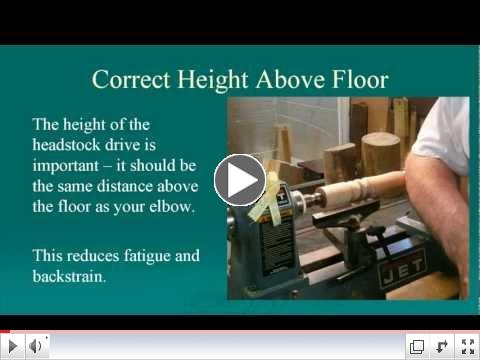
The Mid-South Woodturners Guild has established a Video Safety Group which posts lathe safety videos. Supporters of the project include: Woodturners America, who originated the idea of the fund; the AAW for its strong financial support; the West Tennessee Woodturners for significant funds; and many individuals who have contributed generously.
|
Skill Building Tip
Two-Part Goblet--Toast your Woodturning Skills -by Bob Rosand
About a year ago, we were invited to attend the bat mitzvah of a friend's daughter. Unfortunately, we were unable to attend because of prior commitments, but we wanted to send a meaningful gift. The gift we came up with was a kiddush
cup. Kiddush is a ceremony held at the beginning of many Jewish holy days, including the bat mitzvah (females) and bar mitzvah (males). The kiddush cup or wine goblet is used during that ceremony. Traditionally, kiddush cups are made of gold or silver and many are etched with images of grapes to represent wine. They may include images of birds or animals, people's names, or Old Testament verses.
As a woodturner, I turned the kiddush cup from wood. Using pyrography tools, I burned Mimi's name on the goblet in Hebrew. My wife, Susan, painted the stem portion of the goblet. If you turn a goblet, it may be made out of a single
piece of wood. Or you may turn the goblet in two sections-bowl and stem/foot-as I did. For this project, the bowl section was turned from maple burl and the stem was turned from cherry. Article reprinted from American Woodturner Fall 2005 |
Video Tip
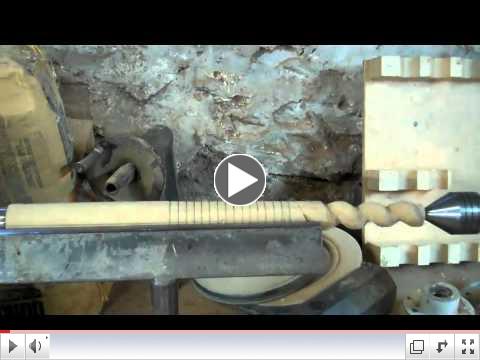 | | How to select a lathe to turn architectural items |
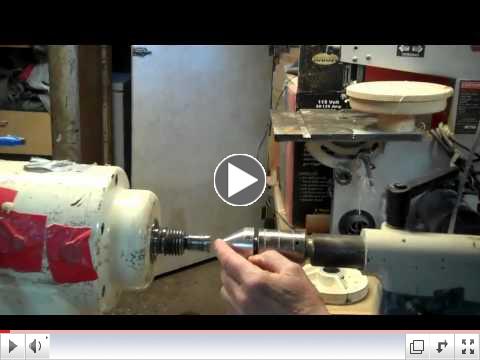 | | How to select a lathe for bowls or large work |
Beth Ireland has been a production woodworker/woodturner for twenty-eight years. She received her MFA in Sculpture in 2010 and uses her turning skill to create sculptural art work as well as traditional architectural pieces. She has just completed a one-year project traveling around the country, teaching traditional hand skills, in a van renovated to be both shop and living space. Learn more about Beth at bethireland.net, and turningaroundamerica.com |
 | | WT Fun question how fast should I run my lathe? |
|
How fast should I run my lathe?
The question often asked, especially by newcomers, is "how fast should my lathe be running?" The answer, as facetious as it sounds, is "it depends." The guiding principle must always be that you run the lathe no faster than is safe. Generally, the quality of the cut is better with the wood moving faster by the edge than slower. That is, of course, with sharp tools and appropriate tool presentation and there is a point of diminishing returns. Depending on the activity -- roughing, interrupted cuts, finishing cuts, detailing, sanding -- different speeds are appropriate. |
|
|
|
|



