|
|
| Issue No. 11.42 | October 20, 2011 |
|
|
|
|

Get Social!
|
|
|
|
|
Bob's Market & Greenhouses, Inc.
Congratulates
The City of Gallipolis
and the
Gallipolis In Bloom Committee
on winning the
National Award for America in Bloom
4,000-10,000 Population Category
This award shows what can be accomplished when individuals, clubs, organizations, and businesses work together for the betterment of a community!
CONGRATULATIONS!
|

Apples: Making History Then & Now
The apple is the pomaceous fruit of the apple tree, species Malus domestica in the rose family (Rosaceae). It is one of the most widely cultivated tree fruits, and the most widely known of the many members of genus Malus that are used by humans.
The tree originated in Western Asia, where its wild ancestor, the Alma, is still found today. There are more than 7,500 known cultivars of apples, resulting in a range of desired characteristics. Cultivars vary in their yield and the ultimate size of the tree, even when grown on the same rootstock.
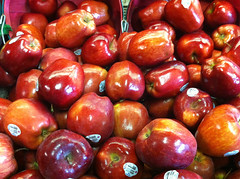
At least 55 million tons of apples were grown worldwide in 2005, with a value of about $10 billion. China produced about 35% of this total.The United States is the second-leading producer, with more than 7.5% of world production.
Apples & History
The apple tree was perhaps the earliest tree to be cultivated, and its fruits have been improved through selection over thousands of years. Alexander the Great is credited with finding dwarfed apples in Kazakhstan in Asia in 328 BC. Apples were brought to North America with colonists in the 17th century, and the first apple orchard on the North American continent was said to be near Boston in 1625.
Apples appear in many religious traditions, often as a mystical or forbidden fruit. One of the problems identifying apples in religion, mythology and folktales is that the word "apple" was used as a generic term for all fruit, other than berries, but including nuts, as late as the 17th century. For example, the Greek goddess of discord, Eris, became disgruntled after she was excluded from the wedding of Peleus and Thetis. In retaliation, she tossed a golden apple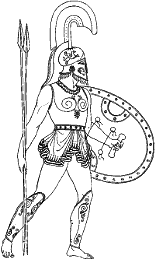 inscribed Καλλίστη (Kalliste, 'For the most beautiful one'), into the wedding party. Three goddesses claimed the apple: Hera, Athena, and Aphrodite. Paris of Troy was appointed to select the recipient. After being bribed by both Hera and Athena, Aphrodite tempted him with the most beautiful woman in the world, Helen of Sparta. He awarded the apple to Aphrodite, thus indirectly causing the Trojan War when Paris took Helen from her husband Menelaus, the king of Sparta. inscribed Καλλίστη (Kalliste, 'For the most beautiful one'), into the wedding party. Three goddesses claimed the apple: Hera, Athena, and Aphrodite. Paris of Troy was appointed to select the recipient. After being bribed by both Hera and Athena, Aphrodite tempted him with the most beautiful woman in the world, Helen of Sparta. He awarded the apple to Aphrodite, thus indirectly causing the Trojan War when Paris took Helen from her husband Menelaus, the king of Sparta.
Apples & Science
In 2010, an Italian-led consortium announced they had decoded the complete genome of the apple, using the Golden delicious variety. It had about 57,000 genes, the highest number of any plant genome studied to dateand more genes than the human genome (about 30,000). This new  understanding of the apple genome will help scientists in identifying genes and gene variants that contribute to disease and drought resistance and other desirable characteristics. Understanding the genes behind these characteristics will allow scientists to perform more knowledgeable selective breeding. Decoding the genome also provided proof that Malus sieversii was the wild ancestor of the domestic apple - an issue that had been long-debated in the scientific community. understanding of the apple genome will help scientists in identifying genes and gene variants that contribute to disease and drought resistance and other desirable characteristics. Understanding the genes behind these characteristics will allow scientists to perform more knowledgeable selective breeding. Decoding the genome also provided proof that Malus sieversii was the wild ancestor of the domestic apple - an issue that had been long-debated in the scientific community.
"Anyone can count the seeds in an apple, but only God can count the number of apples in a seed." -- Robert H. Schuller
|
Mums on Sale NOW!
 All mums are now $4.98 each. Also, if you Buy 4 get 1 FREE! It's not too late to plant them for some fall color and, with a little care, you can enjoy them again next year! |
4th-6th Good for planting Aboveground Crops, Indoors In The North, Outdoors In Lower South.
7th-8th Poor Planting Days. Kill Poison Ivy, Weeds, Clear Land, But Do No Planting.
9th-10th Good Days For Planting Aboveground Crops, Extra Good For Vine Crops, Where Climate Is Suitable.
11th-12th A Barren Period.
13th-15th Good Days For Planting Beets, Carrots, Onions, Turnips And Other Hardy Root Crops, Where Climate Is Suitable. Good Days For Transplanting.
16th-17th Poor Days For Planting, Seeds Tend To Rot In The Ground.
18th-19th Best Planting Days For Fall Potatoes, Turnips, Onions, Carrots, Beets And Other Root Crops, Where Climate Is Suitable. Also Plant Seedbeds, Flower Gardens. Good Days For Transplanting.
20th-23rd Grub Out Weeds, Briars, And Other Plant Pests.
24th-25th Good Days For Planting Root Crops, Fine For Sowing Hay, Fodder Crops, And Grains. Plant Flowers.
26th-28th Good Days For Planting Aboveground Crops And Leafy Vegetables Such As Lettuce, Cabbage, Kale And Celery, Where Climate Is Suitable. Start Seedbeds.
29th-31st Do Clearing And Plowing, But No Planting.
"Love your enemies, for they tell your faults."
-Benjamin Franklin, Poor Richard's Almanack, 1756
|
|

Red-Hot Apple Butter
by: Ramona Knight
Ingredients
- 1 (48 once) Jar, Applesauce (store bought or homemade)
- 2 1/2 Cups, Sugar
- 1/4 Teaspoon, Apple Pie Spice
- 1/4 Teaspoon, Nutmeg
- 1 1/2 Teaspoon, Cinnamon
- 2 Ounces, Red-Hot Candies
Preparation
- Combine ingredients in crock-pot.
- Cook on high about 12-18 hours. Time will vary depending on the thickness of the applesauce.
- Cook until it turns dark brown and thickens.
- It can be stored in the refrigerator or canned in a water bath for 20 minutes.
Send your recipes to ask@bobsmarket.com
|
|
Picture of the Week

A Fresh Arrival of Mums and Pansies in Atlanta
Photo by: Austin Ford
|
|

Check out Bob's Market LIVE, our UStream show, each Friday at 4 pm. You can watch it on our blog, our Facebook page, or directly on Ustream.
Click Here for Last Week's Show
|
Bob's Market & Greenhouses
Mason, West Virginia 25260
1-800-447-3760
|
|
|
|
|
|
|
|
|
|
|








