|
|
| Issue No. 10.40 | October 7, 2010 |
|
|
|
|
Come See Bob's Market at Bob Evans!

October 8-10, 2010
Rio Grande, OH
This year Bob's Market & Greenhouses will have two tents at the Bob Evans Farm Festival! We will have a wide selection of Hardy Mums and Pansies to get you in the mood for Fall. To read more about the festival CLICK HERE.
On FaceBook? Use our FaceBook Event Page for the Festival to share your experience. |
Turning Over a New Leaf
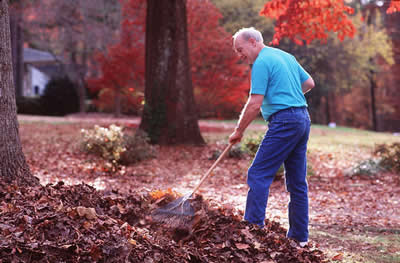 Mulch ado about leaves.There are a large number of expensive, awkward, and sometimes useful products being hawked to suck up your leaves and turn them into mulch. There are blower-vacs which blow leaves into a pile which you can then suck up and shred. There are chipper-shredders with elephant trunks that also allow you to suck up and shred leaves, although you have to rake them into piles first. And lawn jockeys with disposable incomes can check out the over $1,200 self-propelled machines which act like gas-powered vacuum cleaners on your lawn (watch out for small pets).Mower for less.These contraptions may not be the solution for you. However, if you are like most homeowners, you may not have realized that your lawn mower is already a deluxe leaf mulcher in its own right. And perhaps the easiest way to deal with leaves is to mow them right back into the lawn itself. Forget back-breaking raking and bagging!Please note that mower-mulching works best when leaves are relatively dry and are no more than one inch deep. Deeper "drifts" might need to be partially raked first -- or plan to run back and forth over the leaves several times. And do not worry if your model is not a dedicated mulching mower, any type of mower will do.Start your do-it-yourself "mulchinator" by setting the mower to a normal three-inch height. Remove bagging attachments and block off the discharge chute on a rear-discharge machine. Then run your mower over the lawn while walking slowly, giving the mower blades plenty of time to shred up the leaves.If your mower has a side discharge chute, you will probably want to start on the outside perimeter of your lawn and start mowing inward. This will keep the leaf-bits on the lawn, and even allow you to mow over them a few more times. Of course, some folks like to "blow" shredded leaves into ground cover areas, under foundation plantings, or into wooded areas, adding to the organic content of soils there, which is another option.If your first pass over the lawn has left a significant quantity of whole leaves, go back over the leaves while mowing at a right angle to the first cut, perhaps walking even more slowly. Leaves take more work than grass, especially if they are somewhat damp.Too many leaves?The swirling mass of leaves may seem daunting at first, but the final particle size will be one-tenth of the original leaf. This will make it easily digestible by worms and bacteria. Skeptics often voice a concern that shredding leaves into turf areas will overwhelm and kill their lawn. Not at all! In fact, research at the Rodale Institute in Pennsylvania found that earthworms will actually drag a one-inch deep layer of organic matter into their burrows in just a few months, loosening and enriching your soil, and feeding the roots of your lawn for free.Your lawn needs leaves.For decades, homeowners have bagged their grass clippings and leaves and sent them off to a landfill. And lawn chemical salespeople successfully and profitably sold the idea that healthy lawns needed bimonthly fertilizer and pesticide applications. Times have fortunately changed. The fact is that lawns and gardens can be maintained organically, for the most part, and without toxic inputs, just by recycling the natural materials already in place. When you bag up your clippings and leaves, you are short-circuiting the natural recycling process.Think of the cycle this way: tree roots absorb water, minerals, and a host of nutrients from the soil. These materials are used to add girth to the tree trunk and boughs, set forth new branches, grow more roots, and grow leaves, flowers, and fruits or seeds. In a natural setting, such as a forest or woodlot, leaves, small twigs, blossoms, and fruits drop to the ground and slowly decompose, returning all of the original organic building blocks to the soil for future use.What happens when you bag up leaves? How is that organic matter going to get back to the soil for the tree to use in coming years? You may think that by fertilizing your lawn you are returning everything the tree needs. Wrong! Of the more than one dozen major and minor nutrients that plants need to grow, how many are in your bag of fertilizer? And what about the organic matter that creates humus, the very soul of soil itself?Bagging leaves and grass is equivalent to strip mining. The minerals, nutrients, and organic matter are continually stripped away year after year. Eventually, without those vital materials, your trees, your garden, and your lawn will start to suffer. It is time to undo this damage by getting that organic matter back into the soil. And you can easily start just by mowing your leaves into your lawn. Mulch ado about leaves.There are a large number of expensive, awkward, and sometimes useful products being hawked to suck up your leaves and turn them into mulch. There are blower-vacs which blow leaves into a pile which you can then suck up and shred. There are chipper-shredders with elephant trunks that also allow you to suck up and shred leaves, although you have to rake them into piles first. And lawn jockeys with disposable incomes can check out the over $1,200 self-propelled machines which act like gas-powered vacuum cleaners on your lawn (watch out for small pets).Mower for less.These contraptions may not be the solution for you. However, if you are like most homeowners, you may not have realized that your lawn mower is already a deluxe leaf mulcher in its own right. And perhaps the easiest way to deal with leaves is to mow them right back into the lawn itself. Forget back-breaking raking and bagging!Please note that mower-mulching works best when leaves are relatively dry and are no more than one inch deep. Deeper "drifts" might need to be partially raked first -- or plan to run back and forth over the leaves several times. And do not worry if your model is not a dedicated mulching mower, any type of mower will do.Start your do-it-yourself "mulchinator" by setting the mower to a normal three-inch height. Remove bagging attachments and block off the discharge chute on a rear-discharge machine. Then run your mower over the lawn while walking slowly, giving the mower blades plenty of time to shred up the leaves.If your mower has a side discharge chute, you will probably want to start on the outside perimeter of your lawn and start mowing inward. This will keep the leaf-bits on the lawn, and even allow you to mow over them a few more times. Of course, some folks like to "blow" shredded leaves into ground cover areas, under foundation plantings, or into wooded areas, adding to the organic content of soils there, which is another option.If your first pass over the lawn has left a significant quantity of whole leaves, go back over the leaves while mowing at a right angle to the first cut, perhaps walking even more slowly. Leaves take more work than grass, especially if they are somewhat damp.Too many leaves?The swirling mass of leaves may seem daunting at first, but the final particle size will be one-tenth of the original leaf. This will make it easily digestible by worms and bacteria. Skeptics often voice a concern that shredding leaves into turf areas will overwhelm and kill their lawn. Not at all! In fact, research at the Rodale Institute in Pennsylvania found that earthworms will actually drag a one-inch deep layer of organic matter into their burrows in just a few months, loosening and enriching your soil, and feeding the roots of your lawn for free.Your lawn needs leaves.For decades, homeowners have bagged their grass clippings and leaves and sent them off to a landfill. And lawn chemical salespeople successfully and profitably sold the idea that healthy lawns needed bimonthly fertilizer and pesticide applications. Times have fortunately changed. The fact is that lawns and gardens can be maintained organically, for the most part, and without toxic inputs, just by recycling the natural materials already in place. When you bag up your clippings and leaves, you are short-circuiting the natural recycling process.Think of the cycle this way: tree roots absorb water, minerals, and a host of nutrients from the soil. These materials are used to add girth to the tree trunk and boughs, set forth new branches, grow more roots, and grow leaves, flowers, and fruits or seeds. In a natural setting, such as a forest or woodlot, leaves, small twigs, blossoms, and fruits drop to the ground and slowly decompose, returning all of the original organic building blocks to the soil for future use.What happens when you bag up leaves? How is that organic matter going to get back to the soil for the tree to use in coming years? You may think that by fertilizing your lawn you are returning everything the tree needs. Wrong! Of the more than one dozen major and minor nutrients that plants need to grow, how many are in your bag of fertilizer? And what about the organic matter that creates humus, the very soul of soil itself?Bagging leaves and grass is equivalent to strip mining. The minerals, nutrients, and organic matter are continually stripped away year after year. Eventually, without those vital materials, your trees, your garden, and your lawn will start to suffer. It is time to undo this damage by getting that organic matter back into the soil. And you can easily start just by mowing your leaves into your lawn. |
|
- Thursday, October 7 - New Moon
- Friday, October 8 - Harvest Winter Squash
- Monday, October 11 - Columbus Day
- Tuesday, October 12 - Plant Spring Bulbs
- Thursday, October 14 - First Quarter Moon
"Felix quem faciunt aliena Pericula cautum."
Latin, Fortunate the man who learns caution from the perils of others.
-Benjamin Franklin, Poor Richard's Almanac, 1737
|
|
Dolly Sods Cake
Recipe by: Agnes Faber
 "My family enjoys this cake when fresh cranberries arrive in the supermarkets. The name comes from the fact that cranberries are grown in Dolly Sods, WV." "My family enjoys this cake when fresh cranberries arrive in the supermarkets. The name comes from the fact that cranberries are grown in Dolly Sods, WV."
-Agnes Faber
· 2 cups coarsely chopped apples
· 2 cups fresh whole cranberries
· 2 cups sugar
· 2 eggs
· ½ cup vegetable oil
· 1 or 2 tbsp. brandy or bourbon (or 2 tsp. vanilla, but it won't be the same)
· 1 cup chopped black walnuts (no substitutions)
· 2 cups sifted flour
· 2 tsp. baking soda
· 4 tsp. cinnamon
· 1 tsp. salt
Combine apples, cranberries and sugar and let stand. Beat eggs slightly. Beat in oil and brandy. Mix and sift flour, baking soda, cinnamon and salt. Stir flour mixture into liquid alternately with apple/cranberry/sugar mixture. Stir in black walnuts. Pour batter into greased and floured tube or Bundt pan. Bake at 350 degrees for about 1 hour. Let stand until cool. Turn out on rack to complete cooling.
|
|
Picture of the Week

Taken: October 2006
by: John Morgan
|
Bob's Market & Greenhouses
Mason, West Virginia 25260
1-800-447-3760
|
|
|
|
|
|
|
|
|
|
|