|
|
| Issue No. 10.25 | June 24, 2010 |
|
|
|
|
A Birth Announcement
Beth and Alan Barnitz
Proudly Announce That
Aly Beth
Came Into Their Lives
June 23, 2010
Weighing 8 Pounds, 8.5 Ounces |
Flowers on Display

This past week Bob's was proud to supply the flowers for Dummen's booth at the Southeast Greenhouse Conference in Greenville, SC. Dummen is a Germany-based plant breeding company that supplies cuttings that we root for many of your favorite plants. |
DIY Composting
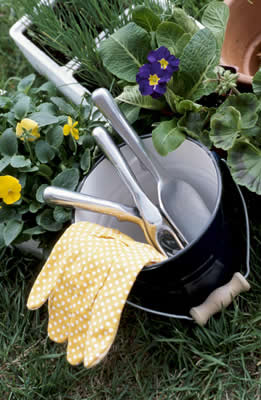
Compost is what you get when yard and garden debris, kitchen scraps and other organic materials have completely broken down into a rich, dark, crumbly material. Gardeners call it "black gold," because it is so rich in nutrients and adds so much value you when add it to your soil. Finished compost is also often called humus, but usually only in really serious sounding books written by uppity, academic types. (FYI for you chickpea fans out there; humus is not the same thing as hummus. So please don't try to eat it!)
In the right conditions, bacteria and other microorganisms quickly break down organic material into rich, fertile earth that you can add to your soil to increase its fertility and health. After the organisms have done their thing, they generate finished compost, which has lots of minerals and micro-nutrients in an easily accessible form for plants.
Composting is cheap and easy to learn, but there is a little bit of an art to it that comes with practice. Breaking down waste requires the right amount of moisture, heat, soil aeration and a proper mix of materials.
Compost bins come in all shapes and sizes. Big, small, short, tall - it's easy to make good compost with them all. Compost bins can be made out of just a few recycled scrap materials, or they can be custom manufactured and loaded with bells and whistles. Compost bins are like cars - the one you choose can be as stylish or as practical as you want it to be.
The simplist type of compost bin is the homemade compost bin. It doesn't have to be perfect, and you can take pride in the "character" of the unit. A compost bin can be made from mesh wire, scrap wood, bricks, cinderblocks, or a combination of those building materials. Scrap yards and construction sites are good sources for this building material - just be sure to talk with the site manager before loading up on materials. Also, never use treated lumber to build compost bins or raised beds that will be used for growing vegetables. The chemicals used to treat the wood is toxic and will leach into the compost or soil.
How quickly compost breaks down depends on four things - moisture, oxygen content, temperature, and a good mix of ingredients. The perfect compost pile is damp without being wet, like a squeezed out sponge. It should also be well aerated, with plenty of the oxygen that aerobic bacteria need. And it should have a mix of different types of materials. If you have just one thing, like grass clippings alone, or leaves alone, then it takes a really long time to break down. But if you have several materials and mix them all together, then they break down much more quickly.
Traditional composting uses microbes to do the heavy lifting, but there are other natural processes that can work even faster. Worms are popular compost helpers - these little workers eat more than half their body mass every day. Worms burrow through garbage and eat soil that's rich in anaerobic bacteria. They excrete soil with even more bacteria, and their waste has helpful aerobic bacteria instead of foul smelling anaerobic bacteria.
|
Growing Greenhouses!
May 2010 |
This summer we're growing something other than flowers at Bob's. We are currently in the process of expanding our greenhouse facilities in Mason, WV. Once completed, this newest addition to the facility behind the Big Red Building in Mason will put us well over 20 acres under roof! To put that in perspective, 20 acres is equal to 1.5 times the area covered by the base of the Great Pyramid of Giza in Egypt!
June 2010 | Nexus Greenhouse Systems of Northglenn, Colorado designed the structure to be built. The new structure will be identical to the greenhouse to the left in the above photo. The new greenhouse will have heated floors, an atrium vent design, and a state-of-the-art climate control system. All of these features will work to make the structure extremely energy effiecent as it is our goal at Bob's to become more "green". |
|
- Thursday, June 24th - End Asparagus Harvest
- Friday, June 25th - Prune Pine Trees
- Saturday, June 26th - Turn Compost
- Tuesday, June 29th - Plant Late Tomatoes
"Time enough, always proves little enough."
-Benjamin Franklin, Poor Richard's Almanac, 1747
|
|
Blueberry Smoothies
Submitted by: John Morgan, Bob's Market
 Ingredients Ingredients
2 quarts (2-1/2 pounds) frozen blueberries, slightly thawed or 2 quarts fresh blueberries
1 quart pineapple, orange, and strawberry juice blend or pineapple-orange juice
1 quart low-fat vanilla yogurt
8 teaspoons sugar
Directions
For each serving: In the container of an electric blender, combine 1 cup (5 ounces) blueberries, 1/2 cup juice, 1/2 cup yogurt and 1 teaspoon sugar. Blend until smooth, about 1 minute. Serve immediately in a tall glass garnished, if desired, with blueberry skewers spiralled with a thin strip of orange peel.
YIELD: 8 portions
Have a favorite recipe? Send it to me for our newsletter! ask@bobsmarket.com

|
|
Picture of the Week

Taken at the koi pond at our Gallipolis, OH Market.
Photo by: John Morgan |
|
|
|
Bob's Market & Greenhouses
Mason, West Virginia 25260
1-800-447-3760
|
|
|
|
|
|
|






