|
|
Next Steps Workshops
| |

A Two-Day Event
Exclusively for Nonprofit
Founders & Long-Term
Executives
Three Vital Tools:
- Sustainability Planning
- Executive Transition Planning
- Succession Planning
- Executive Preparation
- Organizational Preparation
All to ensure the sustainability of your organization, increase board succession competency and staff resiliency for transition.
TWO 2011 WORKSHOPS
October 18-19, 2011
Philadelphia Foundation
Philadelphia, PA
|
Next Steps Workshop
|
JULY NEXT STEPS WORKSHOP
SELLS OUT!
The Next Steps workshop on
July 14-15, 2011 at the Annie E. Casey Foundation was a success. Many waitlisted participants are looking forward to attending our Next Steps workshop in Philadelphia, PA.
July Next Step Workshop Testimonials
"If you're seriously thinking about retiring, this will help you decide when and how to plan it."
"This was a crucial opportunity to get the big picture of executive transition management elements and process."
"A lot of value for the price. I'm leaving with real tools and a solid plan for next steps!"
"The workshop opened up a range of possible tools for me to take back to our board and staff to strengthen our organization."
"Attend! It's imperative for the future of your organization."
"Incredibly helpful, regardless of what stage you're in or if you've ever thought about transitioning."
"It will bring up issues and questions that you have never thought of before."
"If you haven't done work on succession planning, this workshop will provide the impetus and knowledge you need."
"Lots of good tools to help me and my organization move through the transitions effectively."
|
Resources
|
The Nonprofit Leadership Transition and Development Guide: Proven Paths for Leaders and Organizations
by Tom AdamsAvailable from Amazon
Kindle Edition Also Available!
Chief Executive Transitions: How to Hire and Support a Nonprofit CEO by Don Tebbe
Available from BoardSource
Founder Transitions: Creating Good Endings and New Beginnings, by Tom AdamsAvailable from TransitionGuides
Building Leaderful Organizations: Succession Planning for Nonprofits by Tim WolfredAvailable from TransitionGuides
Managing Executive Transitions: A Guide for Nonprofits
Resilient Leadership by Bob Duggan and Jim Moyer
Available from Books on the Web
The Executive Director's Guide to Thriving as a Nonprofit Leader
by Mim Carlson and Margaret DonohoeAvailable from Leadership in TransitionNonprofits: Founder Syndrome
by Bren Monteiro
Available from AmazonWhy Nonprofits Fail: Overcoming Founder's Syndrome, Fundphobia and other Obstacles to Success
by Stephen Block
Available from Amazon
Succession: Are You Ready?
by Marshall Goldsmith
Available from Amazon
Nonprofit Sustainability: Making Strategic Decisions for Financial Viability
by Jan Masaoka & Steve Zimmerman
Available from Amazon
|
|
|
 Greetings! Greetings!
Welcome to the August 2011 issue of the Leadership Guide. We hope you find this issue useful and will forward it to others who may benefit from the ideas, lessons, and stories. As always, we value your feedback and comments. Let us know what topics you would like to read about or personal experiences and insights gained through your work that we could feature in a future issue. Feel free to contact Melody Thomas-Scott at mthomasscott@transitionguides.com.
Best wishes for a continued thriving and leaderful 2011! |
|
Life After Being A Nonprofit Chief Executive
| | |
|
|
Executive Departures: What Are They Doing Now?
| | TransitionGuides had the privilege of interviewing founders and long-term executives who have successfully transitioned from their organizations. We hope sharing their stories, packed with their initial anxieties, preparation and life-after executive leadership is encouraging to those who may be thinking about leaving and to those who are in the process of leaving their organizations. Enjoy!
 | Bob Kardon
|
Bob Kardon was the Co-Founder and Executive Director of the Santa Cruz Community Counseling Center and the California Association of Nonprofits. Later he followed a founder as Executive Director of the Center for Excellence in Nonprofit (CEN) in San Jose. After retiring from CEN, he also served as an interim executive director for three different organizations.
How did Bob feel when it was time to leave? "At Counseling Center, I had reached the point where I was tired of 'chasing money and winning contracts,' plus I was ready for a new challenge. When I started to think about moving on, I took about a week for some reflection, meditation and deep thinking about what was next." Something in Bob's entrepreneurial compass saw the opportunity for some collective action on the part of nonprofit organizations-for public policy, for group purchasing and for training and development. Thus, the California Association of Nonprofits (CAN) was born, also helping to spawn a national movement of state association of nonprofits. "As a founder, I didn't have a lot of fear about what was next, still it was a bit of a leap into the void to go out and start a new organization after having just built one. The Counseling Center provided some office space and support while we were establishing CAN. In any transition, it's important to recognize that you have existing relationships that can support you." One of the lessons that Bob provides is listening to that inner voice that's telling you when it's truly time to move and then having the courage to act on it. Also, a lesson on drawing on your existing relationships to create a support system that facilitates that segue to what's next, whether that's a new organization or building a great life in retirement.
How did Bob prepare the organization for his transition? Bob gave the Counseling Center a year and a half notice of his departure. This allowed the organization to look internally at who might take over and to begin mentoring possible candidates. The Counseling Center also did a great job in seizing the public relations opportunity that came with the transition. "It was important to us that the community see this transition for what it was -- a positive event for the Center." A staff member, who was a natural born organizer, organized a community celebration that was attended by over 500 people and included a mayoral declaration. Externally it was a great public relations moment and internally it was affirming for both board and staff of what they had built together.
Bob's transition into CAN was interesting in that he was hired first as a consultant to then founding director, Bob Daw. CAN was young and very much in the startup phase. Daw hired Kardon as a consultant to help the organization move more fully into service delivery and to help Daw think about his transition plan. The relationship evolved and eventually Kardon was asked to assume the executive director role, which he agreed to do for a three-year term. Daw's passion was fundraising and he stayed on as the director of development. "When I retired from CAN, we fully embraced the William Bridges model of transition - preparation, neutral zone and new beginning. It really helped us focus our thinking about the transition process. Our facilitator was very adept at keeping us from rushing ahead - taking the time to really plan and prepare." The "two Bobs" are great testaments to a leadership handoff process that developed organically but very intentionally, and a post-transition partnership that played to each of their strengths. They built CAN into a very effective model for engaging the resources of the corporate community in capacity building for nonprofits.
What has Bob been up to since his transition? After retiring from CAN, Bob has served as interim executive director for three organizations and is the principal of Kardon & Associates, a Santa Cruz, California-based firm that provides organizational development consultation to nonprofits. For a number of years, Bob has facilitated nonprofit executive director roundtables that provide leaders with a safe space to explore issues they are confronting. Bob enjoys helping coach and mentor younger executives and "being candid about my mistakes." He has also developed a passion for organic gardening with an intensive garden "with 12 different vegetables and various varieties." Bob is a case study taking the time to reflect and identify that powerful idea or passion that's going to draw you forward in the next phase your life-whether that's seizing the idea around which to build a new organization or discovering one's passion for mentoring, gardening and community connections.
What advice would he like to share with other executives? As the departing executive, I think it's really important to fully recognize your role in preparing the way for your successor. That's a lesson I learned more fully when I served as an interim executive director. In some respects, I wished I had had the benefit of that lesson earlier in my career. Preparing the way is both a mindset and a set of actions. The mindset helps you get above some of the political and emotional fray that can come during times of transition. As interim executive, it made my life very clear. It got me thinking about the possibilities of adopting that mindset as a departing executive regardless of whether you are an interim or a departing founder -- organizing your 'departure work' around the question, what can I do to set things up for my successor to have a worklife that would be better, freer and more creative?"
 | Bruce Gottschall
|
Bruce Gottschall was the former Executive Director of Neighborhood Housing Services of Chicago (NHS Chicago) from 1975 to 2009. He developed the Neighborhood Housing Services program in 1974 as a charter member of the NeighborWorks Network.
How did Bruce personally prepare for his transition? Four years prior to his transition, the Fannie Mae Foundation sponsored a yearlong fellowship which required Bruce to be away from his organization to assist other organizations with developing leadership. It was during that year away that Bruce realized that NHS Chicago could keep functioning without him. When Bruce returned from the fellowship, he didn't take on all of the responsibilities he had handed off prior to the fellowship. He realized the staff could maintain their accountability, while freeing him up to do more external outreach. To help prepare himself and the organization for transition, Bruce also attended the Next Steps workshop.
How did Bruce prepare the organization for his transition? Before he announced his retirement, his board approved an emergency succession planning process to see if there was anyone in the organization who could assume his role in the event of a planned or unplanned departure. This helped create a positive psychological commitment without a firm statement that Bruce was leaving. The process helped NHS Chicago strengthen the capacity of the leadership team to keep the organization strong and viable through the transition. As a result, the organization underwent a formal staff development process with outside consultants, and positions were upgraded with revised job descriptions. Looking back, Bruce thinks it might have been better to let the board know of his intent to leave, earlier than he did, because he heard people wondering if the emergency planning was in preparation for his departure. Bruce does feel that it was the right time to depart from the organization.
What has Bruce been up to since his transition? Bruce enjoys not having the same daily routine and likes figuring out what he wants to do on any given day. Because there are not so many people depending on him and in need of a response (other than children and grandchildren), he is able to start his day with a book or something he hasn't done before. Over 15 years ago, Bruce received a harmonica as a gift from his children and he is now taking a harmonica class to learn how to play it well. Recently, Bruce took a refresher Spanish course in Guatemala at a four-hour-a-day tutoring school. Bruce misses the organization and would like to be more engaged, but at the annual dinner with over 700 in attendance, he was able to reconnect with many of the staff.
What advice would he like to share with other executives? Bruce wanted to share this thought with other executives who might be thinking about departing from their organizations: Prepare to leave, but don't focus on working out how you will leave. It will all work out if you prepare. Looking back, Bruce realized he could have stayed with NHS Chicago longer, but he thought about if it would benefit the organization to stay. After carefully and honestly weighing all matters, Bruce knows her left NHS Chicago in good hands.
For two more interviews, see our May Leadership Guide for:
 Sandy Dang, Founder and Former Executive Director of Asian-American LEAD. Prior to transitioning, Sandy took a two month sabbatical where she was completely unplugged from the organization, which gave the board and staff the confidence that there really could be a viable organization after the founder. Read More Sandy Dang, Founder and Former Executive Director of Asian-American LEAD. Prior to transitioning, Sandy took a two month sabbatical where she was completely unplugged from the organization, which gave the board and staff the confidence that there really could be a viable organization after the founder. Read More
 Robert McMahon, Former Executive Director, SCO Family of Services. To prepare his $200 million organization, four years ahead of his transition, Bob and his board began the process of succession planning and strategically building the organization's bench depth. He and his successor made great use of the eight weeks between her hiring and her start date to ensure a healthy handoff. Read More Robert McMahon, Former Executive Director, SCO Family of Services. To prepare his $200 million organization, four years ahead of his transition, Bob and his board began the process of succession planning and strategically building the organization's bench depth. He and his successor made great use of the eight weeks between her hiring and her start date to ensure a healthy handoff. Read More
|
|
|
|
|
|
| Daring to Lead 2011 Report | | |
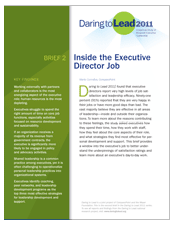
Daring to Lead 2011 is a powerful testament to the current capacity for the good of the nonprofit sector and the enormous potential to grow that capacity and the positive results in communities across this country and the world. This third survey and analysis of nonprofit leadership trends is based on responses of 3,000 leaders. It was sponsored by CompassPoint Nonprofit Services and the Meyer Foundation. Key findings include:
 |
|
- Somewhat slowed by the recession, projected rates of executive turnover remain high - 7% have given notice and 67% plan to leave within five years.
- Many boards are under-prepared to select and support new leaders - new executives report disillusionment with boards actually contribute and only 17% have a documented succession plan.
- The vast majority of organization (84%) reported that they were adversely impacted by the recession, but despite the challenges, executives remained energized and resolved. There were 45% reported being very happy in their jobs and another 46% reported having more good days than bad days in the role.
The report also presents calls for action:
- Plan for successful transitions
- Advance understanding of nonprofit financial sustainability
- Expand and diversity the professional development options available to executive directors.
- Find new ways to improve the performance and enhance the composition of boards.
For more concrete actions to consider, see the article by Tom Adams of TransitionGuides in the June 26, 2011 edition of the Chronicle of Philanthropy.
TransitionGuides has developed a Daring to Lead Actions web page with concrete actions leaders and organizations can take, and tools to make it simple. Look at high performing organizations in any sector -- these leaders and organizations continuously pay attention to leader development and leader transitions. Join the movement to increased results that Daring to Lead invites. See the Daring to Lead Actions web page.
Download the full Daring to Lead 2011 report. Future releases of additional findings can be also found at the same website.
Back to Top |
| Open Searches |
|
- Advocates for Children & Youth, Baltimore, MD - Executive Director
- Alexandria Neighborhood Health Services, Inc., Alexandria, VA - Executive Director
- ASPIRA of Florida, Miami, FL - President and CEO
- Community Design Center of Pittsburgh, Pittsburgh, PA - President and CEO
- Mobile Medical Care, Inc., Bethesda, MD - Executive Director
- National Children's Center, Washington, DC - Chief Executive Officer
- National PTA, Alexandria, VA - Executive Director
- Neighborhood Housing Services of Silicon Valley, San Jose, CA - Executive Director
- Ohio Association of Independent Schools, Sunbury, OH - Executive Director
- Transparency International-USA, Washington, DC - President
|
Back toTop
|
| Next Steps Workshop - For Founders and Long-Term Executives | |
TransitionGuides presents a two-day intensive workshop
exclusively for Founders and Long-Term Chief Executives
October 18-19, 2011 (Philadelphia, PA) Registration fee: $450.00 (only $375 before 8/31/2011)
Sessions include: Session Materials, a Comprehensive Resource CD, and Complimentary Book
*Also includes: Continental Breakfast and Lunch (both days)
|
TransitionGuides Workshops
|

TransitionGuides provides workshops across the country. If you would like to schedule any of the above workshops for your organization, customize a workshop for your members, or learn more about other workshops we offer, visit our website and call our TransitionGuides office (301) 439-6635 today!
|
We hope you found this issue useful and will forward it to others who may benefit from the ideas, lessons, and stories. As always, we value your feedback and comments. Let us know what topics you would like to read about or personal experiences and insights gained through your work that we could feature in a future issue. Feel free to contact Melody Thomas-Scott at mthomasscott@transitionguides.com.
|
TransitionGuides is a consulting firm committed to leadership excellence. Our team of experienced and knowledgeable consultants helps find, support, and guide nonprofit leaders to build and sustain effective, vital organizations. Since 1995, TransitionGuides team has led over 500 executive search, transition, succession and sustainability projects for nonprofits across the country. Clients include local and national nonprofits, foundations, associations, and select government agencies. TransitionGuides offers the wisdom and experience that leading organizations need to identify and harness the power of change.
|
| Join Our List |  |
|
|



