Special thanks to:


.

and
Mike Himelstein
| |
 From the Editor From the Editor
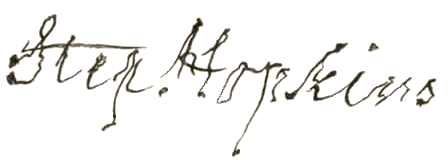
Could this be the oldest signature of an individual with Cerebral Palsy? We don't know for certain. Its author lived a hundred years before the condition was first identified in 1860 by the British surgeon William Little. The signatory's name was Stephen Hopkins, and he called his condition "shaking palsy." Using his left hand to guide his right, he was able to sign his name.
John Adams, the second President of the United States, wrote about Hopkins in his personal diary:
He kept us in Conversation [sic] till eleven and sometimes twelve O Clock [sic]. His Custom [sic] was to drink nothing all day nor till Eight O Clock, in the evening, and then his beverage was Jamaica Spirit and water. It gave him wit, humor, anecdotes, science and learning. He had read Greek, Roman and British History, and was familiar with English poetry. ... And the flow of his Soul made all his reading our own, and seemed to bring to recollection in all of us all we had ever read.
Stephen Hopkins served as governor of Rhode Island when it was still a British colony and, in 1774, authored one of the first anti-slavery laws in North America. His signature above appears on the Declaration of Independence. Stephen was a passionate man with a brilliant mind, much adored by those who knew him.
Hopkins is yet one more example of why a diagnosis of Cerebral Palsy should never be justification for institutionalization nor should it lead anyone to assume cognitive abilities are impaired. Most frequently it is the physical ability to communicate that is most harmed.
 Perhaps that knowledge is what drive musician Neil Young and his wife Pegi. For their work among children with Cerebral Palsy they received honorary doctorates in human letters from San Francisco State University. Young's son Ben, who was born with cerebral palsy, was the catalyst for Pegi's founding of The Bridge School with Jim Forderer, another parent of a severely disabled child, and speech and language pathologist Dr. Marilyn Buzolich. The school's focus has been "to teach children with severe physical and speech impairments how to communicate effectively." Perhaps that knowledge is what drive musician Neil Young and his wife Pegi. For their work among children with Cerebral Palsy they received honorary doctorates in human letters from San Francisco State University. Young's son Ben, who was born with cerebral palsy, was the catalyst for Pegi's founding of The Bridge School with Jim Forderer, another parent of a severely disabled child, and speech and language pathologist Dr. Marilyn Buzolich. The school's focus has been "to teach children with severe physical and speech impairments how to communicate effectively."
Thanh Diep was the first graduate of The Bridge School and is the first alumna to graduate from college. Diep received her BA in 2005 from San Francisco State University. Her experience with Cerebral Palsy has been significantly more physically challenging than that of Mr. Hopkins. Nonetheless her mind is equally brilliant. The Bridge School gave her the ability to communicate. Learn more about Thanh below.
Sadly, despite advance in understanding Cerebral Palsy, individuals with the disability are still stigmatized. Recently, for example, a theology graduate student with Cerebral Palsy made several trips to faith healers earlier in his life. "Lack of faith," he was told, was the reason he still needed leg braces. Perhaps it is our lack of faith that holds him and other like him, back.
There are many efforts to empower persons with Cerebral Palsy. Several little-known agencies from Georgia are highlighted below. Like Childkind, they are charitable organizations. Also like Childkind, they don't consider their works as "acts of charity" to unfortunate people. Instead we all believe our common task is to integrate this diverse population of individuals into society and to provide the tools they need to contribute successfully and to have a joy-filled life. |
Science at Your Finger Tips
|
NINDS
 The National Institute of Neurological Disorders and Stroke (NINDS) conducts and supports research on brain and nervous system disorders. The National Institute of Neurological Disorders and Stroke (NINDS) conducts and supports research on brain and nervous system disorders.
Created by the U.S. Congress in 1950, NINDS is one of the more than two dozen research institutes and centers that comprise the National Institutes of Health (NIH). The NIH, located in Bethesda, Maryland, is an agency of the Public Health Service within the U.S. Department of Health and Human Services. NINDS has occupied a central position in the world of neuroscience for more than 50 years.
The mission of the NINDS is to reduce the burden of neurological disease-a burden borne by every age groups, every segment of society, and people all over the world. To accomplish this goal the NINDS supports and conducts basic, translational, and clinical research on the normal and diseased nervous system. The Institute also fosters the training of investigators in the basic and clinical neurosciences, and seeks better understanding, diagnosis, treatment, and prevention of neurological disorders.
NINDS and Cerebral Palsy
NINDS staff reminds us that Cerebral Palsy doesn't always cause profound disabilities. While one child with severe Cerebral Palsy might be unable to walk and need extensive, lifelong care, another with mild cerebral palsy might be only slightly awkward and require no special assistance. Supportive treatments, medications, and surgery can help many individuals improve their motor skills and ability to communicate with the world.
Researchers are investigating the roles of mishaps early in brain development, including genetic defects, which are sometimes responsible for the brain malformations and abnormalities that result in cerebral palsy. Scientists are also looking at traumatic events in newborn babies' brains, such as bleeding, epileptic seizures, and breathing and circulation problems, which can cause the abnormal release of chemicals that trigger the kind of damage that causes Cerebral Palsy.
Read more about current research and treatment at NINDS - Cerebral Palsy Information.
| |
The Bridge School
 The Bridge School is a non-profit organization whose mission is to ensure that individuals with severe speech and physical impairments achieve full participation in their communities through the use of augmentative & alternative means of communication (AAC) and assistive technology (AT) applications and through the development, implementation, and dissemination of innovative life-long educational strategies. The Bridge School is an internationally recognized leader in the education of children who use augmentative and alternative communication and has developed unique programs and trained highly skilled professionals in the use of state of the art assistive technology. The Bridge School is a non-profit organization whose mission is to ensure that individuals with severe speech and physical impairments achieve full participation in their communities through the use of augmentative & alternative means of communication (AAC) and assistive technology (AT) applications and through the development, implementation, and dissemination of innovative life-long educational strategies. The Bridge School is an internationally recognized leader in the education of children who use augmentative and alternative communication and has developed unique programs and trained highly skilled professionals in the use of state of the art assistive technology.
The Bridge School was founded and its mission established on the beliefs that:
- Everyone should have the opportunity to achieve his or her maximal potential.
- Everyone should have the opportunity to share knowledge, express feelings and be heard
- Everyone should actively participate in his or her own learning.
- All children should have access to a quality education that encompasses a broad base of knowledge and experiences.
- Children, families, and educators must work in partnership to support learning effectively.
- Everyone should have access to a holistic communication system, and technology is a tool that can enhance the communication and learning process.

In 1986 Neil Young did the first annual concert to raise the funds needed to start The Bridge School. The following year the school opened with sufficient resources to gather a "strong professional team" who "developed an intervention model that featured teachers, speech and language pathologists and instructional assistants working collaboratively to teach children with severe physical and speech impairments how to communicate effectively." For more information, please visit www.BridgeSchool.org.
|
|
Many people are familiar with major organizations such as Easter Seals or United Cerebral Palsy. There are many lesser known community-based non-profit organizations in Georgia that are of great benefit to families who are providing care for children with medical or developmental disabilities.
Fragile Kids Foundation

For nearly 20 years, The Fragile Kids Foundation has assisted over 400 children each year with grants of equipment, by distributing items for rehabilitation and referring families to partner organizations working to meet a variety of challenges for medically fragile children.
The ages of children the foundation helps range from birth to twenty-one, though the majority are between two and ten years old. The staff and volunteers assist families through two programs that help them bridge the gap between what insurance and governmental programs will cover and what they truly need to thrive.
Healthcare Grants Program:
The Foundation provides equipment to transport safely medically fragile children without injuring them or their caregivers, as well as specialized equipment for daily care such as:
- Wheelchair lifts
- Ramps to transport children from home to vehicle
- Specialized car seats
- Communication aids
- Toileting and bathing systems
The Foundation will consider a one-time transportation grant to support families requiring assistance to adapt a van for a wheelchair lift or in need of a van with a factory-installed lift. Families may apply annually for other durable medical goods unrelated to transportation. The foundation also has a loaned equipment program.
FOCUSFOCUS was founded in 1983 and to offer emotional, informational and physical support to families of children with disabilities or ongoing medical needs. Since 1983, FOCUS has reached almost 3,000 families in metro Atlanta.
Today, FOCUS also a variety of programs such as support groups, respite care, and summer day camps. FOCUS provides a network for parents to share common experiences and information with each other, building a sense of community for families of children who have disabilities.
Variety of Georgia

Variety - The Children's Charity, provides life-saving and life-enriching assistance to children around the world who are challenged by mental and physical disability, poverty, abuse, and neglect. Variety of Georgia is its local chapter.
Through grants, scholarships, cultural enrichment programs, education, outreach programs, and other activities, Variety supports initiatives worldwide that will mean the difference between a life worth living and, too often, no life at all.
 Funds are allocated to various family services and children's agencies and for summer camp programs to aid disabled, disadvantaged, abused and/or neglected kids, as well as to children who need medical services, mobility equipment, and assistive technology devices such as wheelchairs, van lifts, leg braces, augmentation speech equipment, hearing aids, and various types of prostheses. Funds are allocated to various family services and children's agencies and for summer camp programs to aid disabled, disadvantaged, abused and/or neglected kids, as well as to children who need medical services, mobility equipment, and assistive technology devices such as wheelchairs, van lifts, leg braces, augmentation speech equipment, hearing aids, and various types of prostheses.
For more information, please visit www.VarietyOfGeorgia.org |
Thanh Diep 
In 1991 Thanh Diep, who has Cerebral Palsy, became The Bridge School's first graduate. Then, she entered the sixth grade in her home school district. As she advanced through the educational system, The Bridge School's Transition Program supported her all the way to graduation.
Diep received her Bachelor of Arts degree in 2005 from San Francisco State University where she majored in Liberal Studies. Today, she is a reknown multi-media artist.
Thanh's works include a film based on her poem "Shining Into" and two short films, Nature of Pleasure and Thanh. Additionally, her artwork has been featured in local, national, and international film and art festivals. She frequently addresses sensitive issues such as sexuality and prejudice as it relates to her disability.

Portrait of Neil Young
by Thanh Diep
Acrylic and colored pencil on paper. 2006
See more of her work at Creativity Explored |
|
Other Artists
Other artists with disabilities are supported by The National Arts and Disability Center (NADC). NADC's mission is to promote the full inclusion of audiences and artists with disabilities into all facets of the arts community.
The NADC is a leading consultant in the arts and disability community, and the only center of its kind. Its work is aimed at artists with disabilities, arts organizations, museums, arts administrators, disability organizations and agencies, performing arts organizations, art centers, universities, arts educators, and students. The NADC is a project of the University of California, at Los Angeles.
Click here to hear to learn more NADC. Below are two artists supported by NADC.
Ngay Duc Ta
 Ngay Duc Ta was born in 1955 in Saigon, Vietnam. He was striken with polio when he was one year old. He has loved drawing and music since childhood and is a self-taught artist. Ngay immigrated to the US with his family in 1999 where he began his art career. Today he does portraiture as well as realistic still life and whimsical pieces. Ngay Duc Ta was born in 1955 in Saigon, Vietnam. He was striken with polio when he was one year old. He has loved drawing and music since childhood and is a self-taught artist. Ngay immigrated to the US with his family in 1999 where he began his art career. Today he does portraiture as well as realistic still life and whimsical pieces.
View more of Ngay's work here.
Jessica Keller
 Jessica Keller is an award-winning painter. Her subjects range from portraits to colorful landscapes. She has a special fondness for Polynesian culture. Jessica's desire is to convey a sense of serenity and to share the beauty of Polynesia with those who view her work. Jessica Keller is an award-winning painter. Her subjects range from portraits to colorful landscapes. She has a special fondness for Polynesian culture. Jessica's desire is to convey a sense of serenity and to share the beauty of Polynesia with those who view her work.
Jessica has accomplished what many would-be artists dream of while dealing daily with a rare form of Muscular Dystrophy named Center Core Disease. Currently her work can be seen at Very Special Arts California Gallery in Santa Ana, California, MDA Art Collection in Tucson, Arizona and Clovis Village Art Gallery in Clovis, California.
View more of Jessica's work here. |
Eunice Kennedy Shriver, Founder of Special Olympics
By Daniel Dombey in Washington
Published: August 11 2009 by Financial Times FT.com

A story of family secrets, the love between two sisters and their brother and a drive to help others came to a close on Tuesday [August 11, 2009] when Eunice Kennedy Shriver died at the age of 88.
Shriver was the founder of the Special Olympics for people with learning difficulties, which she built up from a camp for 35 people into an organization involving the participation of some 3m athletes and more than 150 countries.. |
| Next Issue:
A New Beginning
| |
|
|
|



