Special thanks to:


.



and
Mike Himelstein
| |
 Independence! Independence!
On June 22, 1999, individuals with disabilities secured their right to be free of forced institutionalization. The Supreme Court upheld the "Integration Mandate" of the Americans with Disabilities Act. To celebrate the tenth anniversary of this decision, we dedicate this issue of Liberty to the children and families who now have a chance at securing their independence.
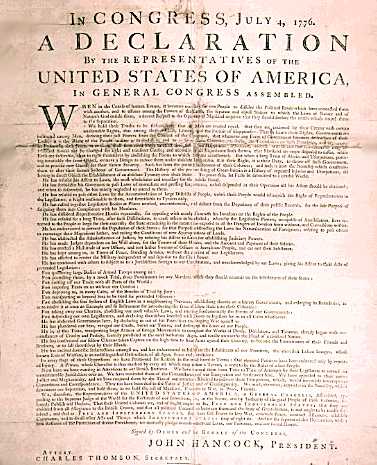
"We hold these truth to be self evident," wrote a 33 year old idealistic Thomas Jefferson, "that all men are created equal, that they are endowed by their creator with certain unalienable rights." Life, liberty, and the pursuit of happiness were those rights he articulated.
It took 214 years for Jefferson's Virginia to elect an African-American as governor. Women couldn't vote until the Nineteenth Amendment to the Constitution was ratified in 1920. An 1800's law called the "Chinese Exclusion Act" that limited the rights of most Asian-Americans remained in effect until 1943 when the Supreme Court declared that law unconstitutional. It wasn't until 1958 that all Native Americans could vote in U.S. elections. Securing independence in order to pursue one's unalienable rights always is a struggle.
 Not institutionalized, many persons with disabilities have made significant contributions to their fields of endeavor. Stephen Hawking, for example, became a professor of mathematics at Cambridge University. In his lifetime Dr. Hawking has become a giant in the field of theoretical physics. "Hawking Radiation," named for a theory that he developed in 1974, is regarded as the first convincing insight into understanding quantum gravity. Not institutionalized, many persons with disabilities have made significant contributions to their fields of endeavor. Stephen Hawking, for example, became a professor of mathematics at Cambridge University. In his lifetime Dr. Hawking has become a giant in the field of theoretical physics. "Hawking Radiation," named for a theory that he developed in 1974, is regarded as the first convincing insight into understanding quantum gravity.
 Blind and deaf at 18 months of age, Helen Keller graduated with a Bachelors degree from Radcliff College in 1904. An unusual achievement for a woman in the early 1900's, never mind the fact that she could not see or hear. She became a world-famous lecturer and author. In 1915 she founded the Helen Keller organization to promote research in vision, health, and nutrition. In 1920 she helped to found the American Civil Liberties Union. By the time she died in 1968 she had authored twelve published books and had met every president from Grover Cleveland to Lyndon Johnson. Her close friends included Charlie Chaplin, Alexander Graham Bell, and Mark Twain. Blind and deaf at 18 months of age, Helen Keller graduated with a Bachelors degree from Radcliff College in 1904. An unusual achievement for a woman in the early 1900's, never mind the fact that she could not see or hear. She became a world-famous lecturer and author. In 1915 she founded the Helen Keller organization to promote research in vision, health, and nutrition. In 1920 she helped to found the American Civil Liberties Union. By the time she died in 1968 she had authored twelve published books and had met every president from Grover Cleveland to Lyndon Johnson. Her close friends included Charlie Chaplin, Alexander Graham Bell, and Mark Twain.
Cognitive ability, the drive for success, curiosity about the world around us, a competitive spirit for sports, or a love of the arts, are not weakened in a person challenged by medical or developmental barriers.
|
|
Olmstead v. LC and EW, a Landmark Case
Article from The Administration for Children and Families, US Department of Health and Human Services.
The Olmstead Decision
The Supreme Court
 The Olmstead case was brought by two Georgia women whose disabilities include [intellectual disability] and mental illness. The Olmstead case was brought by two Georgia women whose disabilities include [intellectual disability] and mental illness.
At the time the suit was filed, both plaintiffs lived in state-run institutions, despite the fact that their treatment professionals had determined that they could be appropriately served in a community setting. The plaintiffs asserted that continued institutionalization was a violation of their right under the ADA to live in the most integrated setting appropriate.
The Olmstead decision interpreted Title II of the ADA and its implementing regulation, which oblige States to administer their services, programs, and activities "in the most integrated setting appropriate to the needs of qualified individuals with disabilities." (28 CFR 35.130(d)). In doing so, the Supreme Court answered the fundamental question of whether it is discrimination to deny people with disabilities services in the most integrated setting appropriate.
The Court stated directly that "Unjustified isolation . . . is properly regarded as discrimination based on disability." It observed that (a) "institutional placement of persons who can handle and benefit from community settings perpetuates unwarranted assumptions that persons so isolated are incapable or unworthy of participating in community life," and (b) "confinement in an institution severely diminishes the everyday life activities of individuals, including family relations, social contacts, work options, economic independence, educational advancement, and cultural enrichment."
Under the ADA, States are obliged to "make reasonable modifications in policies, practices, or procedures when the modifications are necessary to avoid discrimination on the basis of disability, unless the public entity can demonstrate that making the modifications would fundamentally alter the nature of the services, program or activity."
Read the full text here
Read attorney Sue Jameson's article here
Read the Olmstead Decision here
|
The ArkLink organization's National FindFamily RegistryŽ helps locate relatives lost through insitutionalization
For decades, parents of children with disabilities were advised by professionals to institutionalize their child and, in effect, "forget you ever had them." But times have changed. State institutions are rapidly being replaced by smaller, community-based residential settings that support connection between people with disabilities and their families.
Nevertheless, there remain significant numbers of individuals lost through institutionalization. For people seeking to reconnect with family members, the FindFamily Registry at TheArkLink.org might be a great resource.
Learn more about the registry and read family stories here
 TheArcLink Incorporated TheArcLink Incorporated
|
The Southeast is home to major research centers:
Top research will lead to a better understanding of the cause and therapeutic treatment for major developmental disabilitiesI
Vanderbilt Kennedy Center (VKC)
The VKC's mission is to improve the quality of life of persons with disorders caused by the disruption of typical development. Their goals are to support and apply scientific research to bring better services and training to the community.
For more information go to: www.kc.vanderbilt.edu
UAB Civitan International Research Center
The UAB is an interdisciplinary center dedicated to improving lives through brain research and the prevention and treatment of developmental disabilities.
Among the many program areas are [intellectual disability], autism spectrum disorders, treating brain tumors, neonatal seizures, constraint therapy, Rett syndrome, Alexander's Disease, Kernicterus and many more. CIRC's approach focuses on the overall development of the mind and forming a continuum from the laboratory to the clinic to the home and community.
For more information go to : www.circ-uab.infomedia.com
UNC Neurodevelopmental Disorders Research Center
The mission of the UNC NDRC is to support and promote multidisciplinary research and research training on the pathogenesis and treatment/prevention of neurodevelopmental disorders. Major advances towards accomplishing this mission will come from an iterative process; whereby behavioral observations will critically inform basic biological studies and the results of these biological studies will in turn lead to more focused and refined behavioral studies characterizing specific genotype-phenotype relationships.
For more information to go: www.fpg.unc.edu/~ndrc/
|
| The Roosevelt Warm Springs Institute for Rehabilitation helps a young man prepare for independent living
Sammy is an eighteen-year-old who was just graduated from high school. He is outgoing with a charming smile that instantly wins him friends. One would never know he had been a victim of abuse and had spent time in foster care.
Sammy has intellectual disabilities and other developmental challenges. But, through the guidance of his extraordinary foster parents, he has become an exceptional young man striving towards independent living.
This young man now is able to prepare his food, take care of his laundry, and perform a handful of other household chores. Yet, he knows that he still needs to learn more in order to be able to live independently.

Sammy enrolled with the Roosevelt Warm Springs Institute for Rehabilitation. At Warm Springs, he will receive vocational preparation, along with training in the tasks of everyday living. With the help of a supportive and inclusive community, Sammy will be able find work and take care of himself. In time he will be in control of his own life and be a part of the independent community.
With organizations like Roosevelt Warm Springs Institute for Rehabilitation, individuals like Sammy, who have cognitive challenges, can live their lives away from institutions. They can be part of the community and free to pursue their unalienable right of life, liberty, and happiness.
|
Six U.S. Paralympians Nominated for 2009 ESPY Awards
Beth Bourgeois - U.S. Paralympic Team June 30, 2009
Photo by Frank Polick
 COLORADO SPRINGS, Colo. -Six U.S. Paralympians have been nominated for the 2009 ESPY Awards, presented annually by ESPN. COLORADO SPRINGS, Colo. -Six U.S. Paralympians have been nominated for the 2009 ESPY Awards, presented annually by ESPN.
In the category of Best Male Athlete with a Physical Disability, are U.S. Paralympians Jeremy Campbell (track & field/Perryton, Texas) and Will Groulx(wheelchair rugby/Portland, Ore.). In its 17th year, the ESPY Awards will commemorate the most exciting moments, greatest achievements and top performances in athletics around the globe.
All six Paralympic nominees competed in the 2008 Paralympic Games in Beijing, China, where they helped Team USA to its best ever competitive finish in U.S. history. Below is a brief rundown of each of the athlete's athletic achievements.
Read the entire article at www.usparalympics.org/news/article/13873
|
|
Featured Books
Featured books this week are from a series written by Jamee Riggio Heelan, illustrated by Nicola Simmonds, and published by Peachtree Publishers.
The following descriptions are taken from the flyleaf of each book.
THE MAKING OF MY SPECIAL HAND
 EXPERIENCE THE CURIOSITY and eager anticipation of Madison, a small girl born without her left hand, as she tells her story of being fitted for her "special" hand. Her helper hand, a prosthesis, will allow Madison to easily pick up toys, throw a ball, and carry her doll. EXPERIENCE THE CURIOSITY and eager anticipation of Madison, a small girl born without her left hand, as she tells her story of being fitted for her "special" hand. Her helper hand, a prosthesis, will allow Madison to easily pick up toys, throw a ball, and carry her doll.
This enlightening story offers a rare look at the making and fitting of a prosthesis, or in Madison's case, a helper hand. It also explains in a relaxed and informal narrative how the medical team from the Children's Amputee Program worked with Madison and her family.
Madison's story shows us the excitement and promise in one little girl's world, reminding us that nothing is impossible if we have a willing spirit and an enjoyment of life.
ROLLING ALONG
 TAYLOR AND TYLER are twin brothers and best friends. But the twins are different in one significant way: Taylor has cerebral palsy, while Tyler does not. TAYLOR AND TYLER are twin brothers and best friends. But the twins are different in one significant way: Taylor has cerebral palsy, while Tyler does not.
Taylor works hard to strengthen his weak legs in therapy and at home. But when he learns to use a wheelchair, he finds that he is able to get around school more quickly than he could with his walker. He is even able to play basketball with Tyler! Taylor explains why wheelchairs allow many people to be more independent. He also points out why ramps and lowered water fountains are necessary for people in wheelchairs.
This triumphant story offers a valuable look at both adjusting to a wheelchair and facing physical limitations with boundless energy and determination.
CAN YOU HEAR A RAINBOW?
 WHEN CHRIS WAS A BABY, his parents realized that he didn't notice the dog barking or a door slamming. Through a series of tests, doctors determined that he was deaf. In this intriguing, reassuring book, Chris tells young readers about what it is like to be deaf and describes typical events in his life and the ways he has adjusted to his hearing loss. WHEN CHRIS WAS A BABY, his parents realized that he didn't notice the dog barking or a door slamming. Through a series of tests, doctors determined that he was deaf. In this intriguing, reassuring book, Chris tells young readers about what it is like to be deaf and describes typical events in his life and the ways he has adjusted to his hearing loss.
With the assistance of hearing aids, Chris is able to hear vibrations, loud noises, and some other sounds. With sign language, speech therapy, and an interpreter, Chris' days are much like those of hearing children, filled with classes, soccer games, and children's theater.
Accompanied by Simmonds' vivid and energetic multimedia paintings, Heelan's text explores the world of a real child and answers the questions many children may have about hearing loss.
|
About the Authors
The above books were by these two authors.
Jamee Riggio Heelan was born in Evanston, Illinois, one of nine children. She graduated from the University of Kansas with a B.S. in occupational therapy. She has worked at the Rehabilitation Institute of Chicago (RIC) for the past eleven years. She is currently Educational Program Manager for the Kid's Corner of RIC's LIFE Center. Her work is dedicated to treating children and educating others about childhood disabilities. She lives in Mundelein, Illinois, with her husband and four children.
Nicola Simmonds, a native of Brighton, England, holds a BA Honors in Visual Communications from the University of Brighton. She has been involved in the design and production of children's books for more than a decade, both in England and the United States. She now lives in Atlanta, Georgia. |
Another Book to Consider
Hellen Keller, The Story of My Life
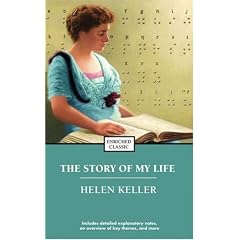 Simon & Schuster (2005) Simon & Schuster (2005)
In this book Helen Keller recounts her childhood through her early adult years. The book includes how she met Annie Sullivan and learned to communicate using sign language.
The Story of My Life was first published in 1903.
They took away what should have been my eyes,
(But I remembered Milton's Paradise).
They took away what should have been my ears,
(Beethoven came and wiped away my tears).
They took away what should have been my tongue,
(But I had talked with God when I was young).
He would not let them take away my soul -
Possessing that, I still possess the whole.
-Helen Keller
| |
| Next Issue:
A Labor of Love
|
|
|




