|
|
|
|
|
Yiddishkayt in March
Sholem Aleykhem!
We hope you'll join us this weekend, as yidARTS presents the film Schund! by the young Israeli filmmaker Yael Leibovitz-Zand as part of the Israel Film Festival. Not exactly a mockumentary, Schund! weaves fact and fiction to present a portrait of Yiddish culture in Israel featuring vibrant personalities, eccentric bohemians, and radical artists. While it skews away from reality, the film also explores what Yiddish theater has come to mean for a new generation of Israeli young people exploring their own personal histories. Afterward, you're invited to an intimate conversation with Mike Burstyn about the realities of presenting Yiddish theater in Israel and a panel discussion about the film.
And while we're talking about Yiddish theater, join us this summer on a Yiddishkayt Expedition. This summer we explore Yiddish theater and the beautiful landscapes where it was created. Find out more below or give us a call to sign up.
אַל דאָס גוטס -- Best Wishes,
Yiddishkayt
|
|
|
MARCH 2012
|
YidBits Vol. 7 No. 3a bisl yiddishkayt
|
|
|
yidARTS 2012 in March
SCHUND at the Israel Film Festival
 followed by a conversation with Mike Burstyn followed by a conversation with Mike Burstyn
3.17.12 * 6:30 P.M.
Laemmle's Music Hall (click for map)
9036 Wilshire Boulevard (at Doheny) Beverly Hills 90211
| |
YidARTS 2012 continues this weekend as Yiddishkayt presents Schund! at the 26th Annual Israel Festival, followed by a discussion with Yiddish and Hebrew theater and film legend Mike Burstyn, Saturday evening, March 17th at 6:30 p.m.
SCHUND!, a clever and heartfelt mockumentary, is a kind of Yiddish theatrical Forrest Gump, "introducing" a renowned Yiddish actor who disappeared under criminal circumstances. Left in his wake are debts, rumors, and a mysterious inscription on the door of his home reading "shund." The film's action takes place 25 years after the actor's disappearance as the young filmmaker struggles to pick up his trail. The screening will be followed by a conversation with Mike Burstyn, who along with his renowned family, shattered the taboo associated with Yiddish performance in Israel, and a discussion with UCLA theater Professor Shelley Salamensky and Yiddishkayt's executive director Dr. Robert Adler-Peckerar.
For more information, or to buy tickets online, visit yiddi.sh/iffschund.
Here's a clip from 1960 of a teenage Mike Burstyn performing Shabes nokhn kugl with his father Pesachke Burstyn.
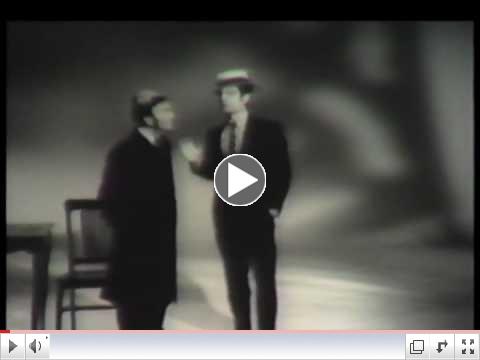 Mike & Pesachke Burstyn, Shabes Nokhn Kugl, 1960 Mike & Pesachke Burstyn, Shabes Nokhn Kugl, 1960 |
|
|
MARK YOUR CALENDAR FOR YIDARTS IN APRIL!
Treasures of Yiddish Folkong with Mark Levy
4.14.12 * 8:00 P.M.
Genghis Cohen
740 North Fairfax Avenue
Los Angeles 90046
Come end Passover with some Chinese food and classic Yiddish music. Mark Levy comes to Genghis Cohen with a diverse range of Yiddish songs. Levy has appeared throughout the country and abroad specializing in older Judaic folk music in Yiddish, Hebrew, and Ladino, klezmer history and theory, and Jewish music history in general. He has performed for Yeshiva University's Sephardic Department's Semana Sepharad in New York, and is a cantorial soloist in California.
Check yiddishkayt.org for more information!
|
| Yiddishkayt Expeditions
Heading to Europe this August
The Cradle of Theater and Song 
14-24 August 2012 * Romania, Bessarabia, Ukraine, Turkey
In the Footsteps of Great Jewish Writers
26 August-5 September 2012 * Kiev, Bukovina, Galicia, Vienna
Journey into Yiddish culture this summer on our luxury tours of Europe. Custom-crafted by award-winning Mir Travel, these unique expeditions bring you to the historic heartland of Jewish life in Europe.
 Our Cradle of Theater and Song trip commences in Bucharest before heading to Iasi, the birthplace of Yiddish theater. Then, we head across Bessarabia (today, Moldova) as we bring Aaron Lebedeff's classic Romania, Romania to life with wine, song, and plenty of mamaliga. Or, travel In the Footsteps of Great Jewish Writers, from Sholem Aleichem to Sigmund Freud, as we journey from the imperial metropolis of Kiev through the great cities and shtetlach of Galicia and the Austro-Hungarian Empire. Both trips allow you to jump off for a personally-guided tour of your family's historic town or village.
|
|
Der Vortsman
Of Dictionaries and Hats
A reader wrote: "In the Yiddish I spoke all my life 'moyde' meant 'forgive.' I recently learned that in Hebrew it means 'thanks.' I would like to know how this exchange came to be." 
Der Vortsman, hardly a Hebraist, sought enlightenment from his dictionaries: Yitskhok Niborski's indispensable Verterbukh fun loshn-koydesh verter in yidish (Dictionary of Holy-Tongue [i.e., Hebrew/Aramaic] Words in Yiddish) and The New Bantam-Megiddo Hebrew & English Dictionary.
Niborski confirmed that Yiddish uses the Hebrew-origin word moyde in the varied senses of admission, forgiveness...and of thanks. Moyde zayn zikh is to admit to one's own transgression. Moyde zayn means to forgive another's misstep. Moyde ani is the beginning of the prayer of thanksgiving ("I give thanks...") recited by the observant upon awakening and going to sleep.
This apparent overlap in meaning exists in Hebrew usage, as well. The Bantam Dictionary defines moda in the Hebrew-English section as "thankful, grateful; admitting." However, in the English-Hebrew section, both "grateful" and "thankful" are given as asir-toda (which shares the same root as moyde) .
Der Vortsman confesses to giving thanks that he's not a lexicographer (English: dictionary compiler).
Sholem Aleichem (as his family prefers it be spelled-otherwise, Aleykhem) wrote a story called, in its published translation, "On Account of a Hat." Der Vortsman was recently involved with a hat of a different color.  | |
Hat Tartare: an actual toterish hut
|
We've been involved for several years with the re-translation (the original effort was a horror) of the yizker bukh (memorial book) of the Ukrainian shtetl Felshtin. The book, unlike most others of the genre, does not memorialize a destruction during the Nazi-era khurbn (hurban, holocaust, shoah), but the pogrom by Ukrainian nationalists in 1919, during the anti-Bolshevik civil war. It was published in 1936 and hailed as the most impressive of similar books of that period. We referred to the book and its devotedly meticulous editor in our last (Feb., 2012) column.  | |
Charles Bronson, son of a Tatar, in a non-Tatar Hat
|
That editor recently asked about a reference in the book to a toterish hut, a "Tatar hat" and wondered whether it wasn't a typographical error in the original Yiddish, that it should have been a "Tartar hat." Der Vortsman replied -- and a Ukrainian friend of the editor's confirmed -- that "Tatar" was correct and that it referred to the Tatar people. The Tatars, in fact, once occupied parts of Poland-Lithuania, Ukraine, and Crimea, and small groups remained there after the Russians reclaimed the area. So it made sense that a hat made in the Tatar style or by Tatars would be available in the Felshtin marketplace. Too, there's the common Yiddish expression redn af toterish (speaking in Tatar) meaning to babble nonsensically. The recent history of the Crimean Tatars also intersects with recent Jewish history. Stalin's paranoia led to the mass exile to Siberia of the Tatars during WWII; later, the main charge against the leaders of the Jewish Anti-Fascist Committee in 1949-50 was their "plot with American Jews" to sever Crimea from the USSR and to set up a Jewish state there. Now, that was nonsensical babble in any dictionary.
Kedey tsu zen dem arkhiv funem vortsman...
|
|
Yiddish around L.A.
Yiddishkayt at Valley Beth Shalom
 3.24.12 * 12:30 - 2:00 P.M. 3.24.12 * 12:30 - 2:00 P.M. Valley Beth Shalom
15739 Ventura Boulevard, Encino
The great Yiddish poet Yankev Glatshteyn once wrote: " S'veln nokh royshn grine bleter/Af undzer boym dem farkvartn (Green leaves will again rustle/On our withered tree." Come hear Yiddishkayt's Executive Director Dr. Rob Adler-Peckerar speak about the vibrant history of Yiddish culture and the promise of future green leaves. He'll also talk about Yiddishkayt's exciting new programs and activities including the ground-breaking Helix Project and Yiddishkayt Expeditions.
Yiddish Music & Socialism: The Life of Victor Berger
 3.25.12 * 3:00 - 5:00 P.M. 3.25.12 * 3:00 - 5:00 P.M. Workmen's Circle/Arbeter Ring
1525 S. Robertson Boulevard, Los Angeles
A very special concert by Yale Strom, Elizabeth Schwartz, & Mark Dresser celebrates Yiddish culture's rich tradition of progressive values and great music, marking the 102nd anniversary of the election of Victor Berger, a German-Jewish immigrant and co-founder of the Socialist Party of America, who became the first socialist to win a seat in the U.S. Congress. The program will be filled with progressive Yiddish songs and klezmer music -- fun for all Yiddish, history, and music lovers.
For reservations or more information, call (310) 552-2007.
|
 Historical Yiddishkayt Historical Yiddishkayt
The image at the top of this month's YidBits comes from the frontispiece of the book Friling (Spring) by the Soviet Yiddish writer Shmuel Gordon (1909-1998). Gordon, who was born in Kovno, spent years in a Gulag and later became one of the most prolific writers for the Yiddish journal Sovetish Heymland (Soviet Homeland).
Like us on Facebook for more Yiddishkayt history, including Today in Yiddishkayt, where you can find out about major figures and events in the history of Yiddishkayt throughout the world.
|
 YidBits and YidPicks are made possible in part by a grant YidBits and YidPicks are made possible in part by a grant
from the City of Los Angeles, Department of Cultural Affairs 
3780 Wilshire Boulevard, Suite 1000 | Los Angeles, CA 90010
|
|
|
|
|
|





