|
|
|
|
|
Yiddishkayt in February
Sholem Aleykhem!
We admit it might be a stretch to include St. Valentine's Day in a Yiddishkayt calendar. But we're always happy to find an excuse to celebrate love and affection and with the overturning of Prop 8 this month, it seems like an apt time to sing songs of romance and marriage. This month our yidARTS concert celebrates the vicissitudes of love at the West Hollywood Library. If you missed the premiere concert at this new beautiful venue, you simply must come to hear masters of traditional music Michael Alpert and Julian Kytasty perform Love Songs from a Neighboring Village: Music From the Pale. Our 2012 season continues with this amazing concert, drawing inspiration from languages coming together to form new, creative results. All yidARTS events are low-cost (or even free!).
From the music of the Pale in West Hollywood to the actual Pale of Settlement in Eastern Europe, Yiddishkayt is getting ready for our first-ever expedition. Now is the time to register for this summer's Yiddishkayt Expeditions. These unique, luxury tours journeying through the history of Jewish life in Eastern Europe are not to be missed. Find out more below.
צום זען זיך -- Hope to see you this month!
Yiddishkayt
|
|
|
FEBRUARY 2012
|
YidBits Vol. 7 No. 2a bisl yiddishkayt
|
|
|
yidARTS 2012 in February
Michael Alpert & Julian Kytasty
Love Songs from a Neighboring Village
2.18.12 * 7:30 P.M.
| |
YidARTS 2012 continues in February with Love Songs from a Neighboring Village with the generous support of the City of West Hollywood at the West Hollywood Library on February 18th at 7:30 p.m.

Following their acclaimed collaboration, Night Songs from a Neighboring Village, masters of traditional Eastern European music Michael Alpert and Julian Kytasty join forces once more for a musical celebration of love. Alpert and Kytasty bring the intertwined musical traditions of Ashkenaz and Ukraine to West Hollywood. From lyrical love songs and ballads of courting to melodies of marital mayhem and tragic separation, Love Songs from a Neighboring Village shares the intricacies of love as reflected in the musical culture of the Pale of Settlement.
This new venue is an intimate space, so be sure to reserve your seats in advance. General admission tickets are $8, t o purchase tickets, visit yiddi.sh/YidLove. Senior and student tickets are free, email events@yiddishkayt.org to reserve complimentary seats. In the meantime, enjoy this clip of Michael Alpert and Julian Kytasty.
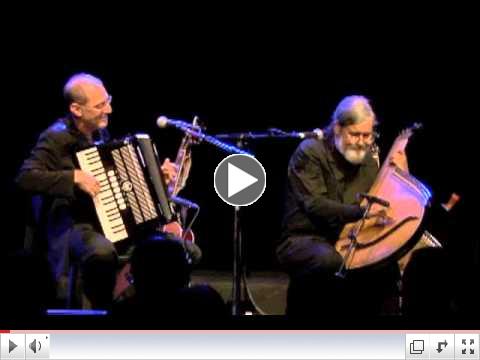 | | Michael Alpert and Julian Kytasty play West Hollywood 2.18.12 |
|
Yiddishkayt Expeditions
 Heading to Europe this August The Cradle of Theater and Song
14-24 August 2012 * Romania, Bessarabia, Ukraine, Turkey
In the Footsteps of Great Jewish Writers
26 August-5 September 2012 * Kiev, Bukovina, Galicia, Vienna
Journey into Yiddish culture this summer on our luxury tours of Europe. Custom-crafted by award-winning Mir Travel, these unique expeditions bring you to the historic heartland of Jewish life in Europe.
Our Cradle of Theater and Song trip commences in Bucharest before heading to Iasi, the birthplace of Yiddish theater. Then, we head across Bessarabia (today, Moldova) as we bring Aaron Lebedeff's classic Romania, Romania to life with wine, song, and plenty of mamaliga.
Or, travel In the Footsteps of Great Jewish Writers, from Sholem Aleichem to Sigmund Freud, as we journey from the imperial metropolis of Kiev through the great cities and shtetlach of Galicia and the Austro-Hungarian Empire.
Both trips allow you to jump off for a personally-guided tour of your family's historic town or village.
|
|
MARK YOUR CALENDAR FOR YIDARTS IN MARCH!
Schund! at the Israel Film Festival
3.17.12 * 6:30 P.M.
Laemmle Music Hall 3
9036 Wilshire Blvd
Beverly Hills 90211
 Yiddishkayt presents SCHUND! at the Israel Film Festival Saturday, March 17 at 6:30 p.m.
SCHUND!, a clever and heartfelt mockumentary, is a kind of Yiddish theatrical Forrest Gump, "introducing" a renowned Yiddish actor who disappeared under criminal circumstances. Left in his wake are debts, rumors, and a mysterious inscription on the door of his home reading "schund." The film's action takes place 25 years after the actor's disappearance as the young filmmaker struggles to pick up his trail.
The screening will be followed by a panel discussion featuring Yiddish and Hebrew legend Mike Burstyn.
|
|
Der Vortsman
whatever
Strange: Just as one reader asked a question, another posed a query that responded to the first - almost.
Reader 1: "How would you say 'whatever' in Yiddish? I mean, the way that word is now used, dismissively, especially by teenagers."
Reader 2: "My parents used to say 'nit gepidlt' when they meant to dismiss something as unimportant. Does it have anything to do with 'piddling?'"
 Der Vortsman informed Reader 2 that his memory or hearing was faulty...that the phrase his parents used was actually 'nit gefidlt' meaning "so I/you/it didn't fiddle"...that it was unrelated to "piddling." The thought then occurred that the phrase was an apt folk-expression that would fit today's teenage "whatever." However, while looking up an entirely different word in Yitskhok Niborski's indispensable dictionary of Holy Tongue (Hebrew/Aramaic) words in Yiddish, we came across "loy fidalti," a Yiddishized Hebrew phrase meaning "so I didn't fiddle." Moreover, the "Hebrew" is actually a parody of the biblical phrase "loy filolti," meaning "I had not thought [to see your face]."
Another reader, who knows Yiddish well, inquired about the word "tanebatek" and guessed that it meant, literally, "a fine fellow," but that it was used ironically. She was not far off. Again, Niborski to the rescue: The Aramaic "táne" refers to a highly-respected teacher of the Rabbinic period during the early years of the Current Era, who collectively created the Mishnah, the base of the Talmud. A "táne báre" is an "Unnamed Teacher," i.e., not really a learnèd teacher at all. Yiddish took over the ironic phrase and further parodied it into tane-bartek, meaning "a not-so-nice guy."
From ancient Aramaic teachers and tomes to...would you believe...Japanese!  Last month, the Forward ran a long article about a Yiddish-Japanese dictionary that contains 28,000 entries in 1,302 pages and goes for the modest price of 60,000 yen, or around $770!
The article makes much of the fact that the number of entries exceeds that of the Modern English/Yiddish, Yiddish/English Dictionary, but the writer mistakenly credits Max Weinreich as its compiler. It was actually Max's son, Uriel. (Der Vortsman notes that Nahum Stutchkoff's Thesaurus of the Yiddish Language comprises over 150,000 words, idioms, phrases and proverbs.) Finally, readers of this column who check will note that the very last word in the article is a grievous error in Yiddish.
Speaking of dictionaries, it's important how one uses them. A friend and Yiddish-knower asked: "Is 'ongepatshket' a real Yiddish word?" She'd been unable to find it in Uriel Weinreich's dictionary. Had she looked up the verb "onpatshken," she'd have found it, defined as "make a mess; scribble." Harkavy (1928), somewhat more acutely, says it means "to dirty, soil," while in 1898 he included "to make dirt." Were Der Vortsman a lexicographer, he'd add: "to decorate sloppily, tastelessly." But such extended definitions by a tane bare might add untold pages (and yen-costs) to the Yiddish-Japanese dictionary; iz nit gefidlt.

The same Yiddish-knowing friend challenged another in her city over the legitimacy of the word "umgelumpert" and asked for validation. While Harkavy did not include it in the Yiddish-English part of his 1898 dictionary, he did in the much larger English-Yiddish section under "clumsy," though spelling the Yiddish as "ungelumpert" with an "n" (a nun, actually). In his 1928 Yiddish-English-Hebrew Dictionary, Harkavy got it right on all counts. (There is absolutely no evidence to suggest that Roald Dahl used "umgelumpert" when creating Willy Wonka's Oompah Loompahs.)
Finally, a query from the devotedly meticulous editor of the English translation of the yisker bukh - memorial book - about the shtetl Felshtin, destroyed in 1919 by Ukrainian Nationalist pogromist brigands during the civil war following the Russian Revolution. He asked about a word that appeared in the 1936 original Yiddish edition, "obshay." The dictionaries we've cited above show both that archaic spelling and the more modern "opshay." The definitions include "respect, reverence, awe" and, in one case - as the first definition - "fear." A discussion with the Learnèd Editor of YidBits yielded some fascinating possibilities about the origins of the word - which we'll spare our readers - but also the reminder that, in English, "awe" also metamorphoses into "awful."
Awesome. Or, whatever.
Kedey tsu zen dem arkhiv funem vortsman...
|
|
Yiddish around L.A.
The World of Yiddish Folksong
2.17.12 * 8:00 P.M.
Valley Beth Shalom
15739 Ventura Boulevard, Encino
Cantor Herschel Fox, with guest Shira Fox, leads a special, Yiddish-themed farbrengen and festive oyneg shabbes "capped off by tantalizing nasheray."
Mostly Kosher - Klezmer, Yiddish and All That Jazz!
 2.19.12 * 2:00 P.M. 1st Congregational Church of Long Beach 241 Cedar Avenue - Long Beach Join the studio audience at the First Congregational Church of Long Beach for the taping of the Klezmer and Yiddish radio show hosted by Leeav Sofer and his Mostly Kosher band.
|
 Historical Yiddishkayt The image at the top of this month's YidBits is from an anonymous painting hanging in the Ukrainian Museum of Fine Arts in Kiev. The work, simply titled Bandura-Player, dates from the early 19th century. Alongside the image is a verse from the song "Nem mir aroys a ber fun vald," taken from Ginzburg and Marek's 1901 collection of Yiddish folksongs. This classic love song of impossible deeds begins:
"Nem mir aroys a ber fun vald
Un lern im oys shraybn.
Oto dentsmolt un oto dentsmolt-
Vel ikh dayne blaybn...
Catch me a bear out of the forest
And teach him how to write--
That's when and just that's when
I'll be your very dearest..."
Like us on Facebook for more Yiddishkayt history, including Today in Yiddishkayt, where you can find out about major figures and events in the history of Yiddishkayt throughout the world.
|
 YidBits and YidPicks are made possible in part by a grant
from the City of Los Angeles, Department of Cultural Affairs 
3780 Wilshire Boulevard, Suite 1000 | Los Angeles, CA 90010
|
|
|
|
|
|